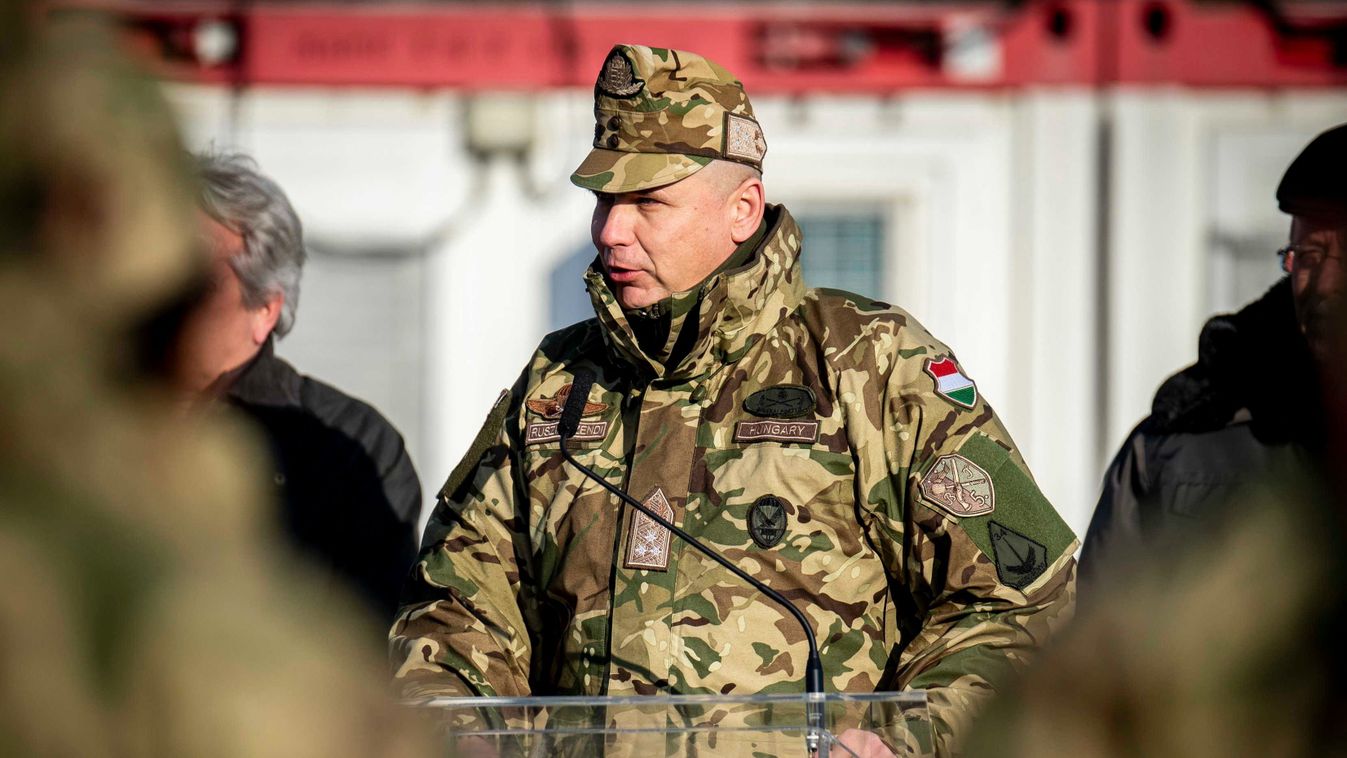
Soldiers at a party event?
Ellenpont pointed out that the Fundamental Law explicitly enshrines the principle of the political neutrality of the Hungarian Defense Forces, under which
professional soldiers are not allowed to engage in political activity and to be members of political parties.
The detailed rules are set out in the law governing the legal status of soldiers: Section 22(4) states that members of the contracted personnel must suspend their party membership for the duration of their service. A government decree on the legal status of soldiers is also clear in stating that personnel may not hold party membership and may not engage in political activities. In addition, Section 5(1) specifically addresses voluntary reservists:
for them, not only is party membership prohibited, but they are also barred from appearing at party events.
Higher-level legislation primarily prohibits the political involvement of soldiers, while the detailed rules governing the participation of the armed forces as an institution in social events are laid out in a separate defense ministry directive.
Under the regulation, the armed forces may participate in social events in exchange for compensation. But what falls into this category? The law provides a clear answer: “State, national, religious, social celebrations, cultural and sporting events organized by state bodies, local governments, churches, civil society organizations dedicated to preserving traditions and national defense, and educational institutions.”
It is notable that political events are not included in this list. This is no coincidence: Section 5(1)(c) of the defense ministry directive clearly states that the armed forces may not participate in events connected to political parties’ activities. Peter Magyar’s May 9 “public celebration” clearly qualifies as a political party’s event, since by Magyar’s own admission it is financed by the Tisza Party.
The current legal framework does not allow the defense forces to take part in such an event.
Politicians from the incoming governing party will likely attempt to present the event as a state celebration, but Peter Magyar has made it clear that it is organized and financed by the Tisza Party. And this is not the only irregularity in the case.