PM Orban: First Battle Won, Second Comes on April 12

After the EU summit in Brussels, Viktor Orban stated that Hungary has won the first battle by resisting the Ukrainian war loan, warning that Brussels is now counting on a political change on April 12 to install a pro-Ukraine government. He added that if this happens, the Druzhba oil pipeline may never reopen, which would lead to 1000-forint fuel prices and the end of utility price caps in Hungary.

2026. 03. 20. 16:49
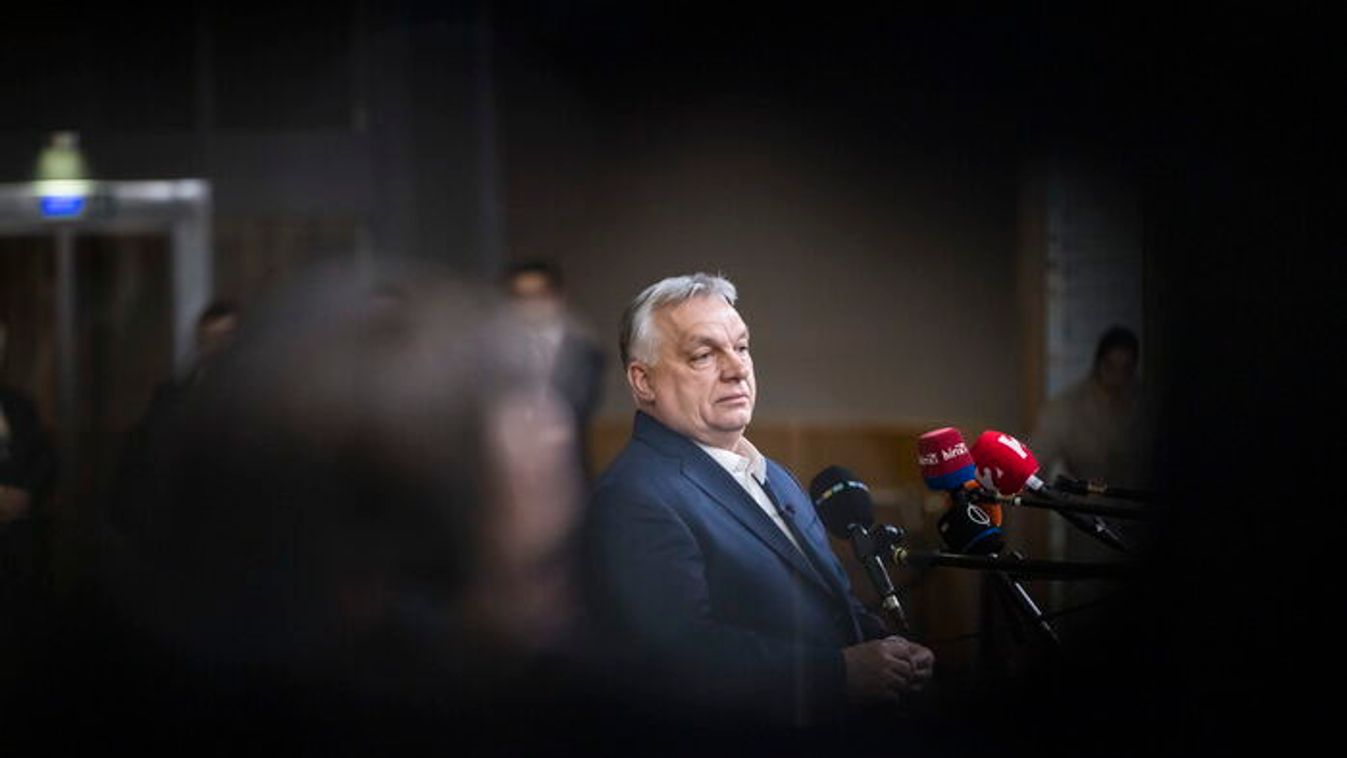
Hungarian Prime Minister Viktor Orban speaks to the press after leaving the summit of EU heads of state and government in Brussels on March 20, 2026 (Photo: MTI/Prime Minister’s General Department of Communication/Akos Kaiser)
VéleményhírlevélJobban mondva - heti véleményhírlevél - ahol a hét kiemelt témáihoz fűzött személyes gondolatok összeérnek, részletek itt.

The Hungarian prime minister held a press briefing in Brussels on the developments at the EU summit. Following the meeting, Viktor Orban stated: "If Hungary had been placed under an oil blockade in December, we would not have agreed to this 90 billion loan. However, since  Ukraine waited for this positive decision and only then imposed the oil blockade, they cannot ask me to act as if nothing had happened."

Brüsszel, 2026. március 20.
A Miniszterelnöki Kommunikációs Főosztály által közreadott képen Orbán Viktor miniszterelnök (k) nyilatkozik az EU-tagországok állam-, illetve kormányfőinek csúcstalálkozójáról távozva Brüsszelben 2026. március 20-án. Mellette Máté János, a Miniszterelnöki Programirodát vezető államtitkár.
MTI/Miniszterelnöki Kommunikációs Főosztály/Kaiser Ákos
Prime Minister Viktor Orban (center) speaks to the press after leaving the summit of EU heads of state and government in Brussels on March 20, 2026. Next to him is Janos Mate, State Secretary heading the Prime Minister’s Program Office (Photo: MTI/Prime Minister’s General Department of Communication/Akos Kaiser)

Viktor Orban added that he had made it clear Hungary upholds the December decision. 

At the press briefing on Friday, Viktor Orban emphasized: “In December, we made a decision that the European Union would provide a 90 billion euro loan to Ukraine, which we consider a mistaken and strategically flawed decision. We reached a compromise that three countries—those that consider this a mistake and do not wish to bear the resulting financial burden, namely the Czechs, the Slovaks, and us—would give their consent to the loan, but would not participate in its disbursement and would not assume its financial costs. That was the agreement.”

He stressed: “Since this is not only a strategic mistake for Hungary, the Czech Republic, and Slovakia, but for the entire European Union, and we do not want our common Europe to suffer as a result, we could have refused to give our consent. But we did not do that. Instead, we agreed that the loan could be disbursed without us.”

At that time, the Druzhba oil pipeline was still delivering. As I said yesterday, if we had already been placed under an oil blockade by the Ukrainians at that time, I would never have agreed that Ukraine could receive a loan from here in Brussels, even without Hungary. The situation changed in February, when Ukraine placed Hungary under an oil blockade. The dilemma I faced was whether to act as if nothing had happened, or to say that if there is no oil, then there is no money,

the prime minister stated.

“Once we had ascertained that the pipeline is operational and that the decision is of a political nature—and President Zelensky even did us the favor of stating openly that he has no intention of restarting the pipeline, as he does not agree with its operation—this opened the way for me to tell the European Union that since the lending process has not been concluded and a formal decision is still required, Hungary will refuse that formal decision. This is what led to yesterday’s situation,” he explained.

And what may seem like a theoretical issue here in Brussels becomes, in a given country—in this case Hungary—an existential question. Is there oil or is there no oil? To create a situation 30 days before an election where there is no oil in Hungary, leading to panic and chaos, is a reality to which a sovereign government must respond. Therefore, I maintain my position. And that is what we did. Despite bullying, jabs, and attempts to carve us up, we upheld our position,

Viktor Orban underlined.

Brussels wants a pro-Ukraine government

Speaking about international reactions, he said: “I see that this is not well received. I see that the German chancellor used strong words. The German-Hungarian relationship is special. The timing of the chancellor’s remarks does not reflect good judgment. He could have waited a day. On the anniversary of Germany’s occupation of Hungary, it is not appropriate to threaten those whom you once occupied, deported Jews from, and plundered. The chancellor could have respected that fur us this is a time of remembrance for our victims instead of engaging in disputes,” he emphasized.

The situation here in Brussels is quite clear. The reason they did not roll me up in a carpet and take me to a secret location, but allowed me to go, is because they believe they can endure this short remaining period even standing on one leg. They are hoping that on April 12 there will be a change in Hungary. And if there is a change, they will get a government that is pro-Ukraine, pro-Brussels, and will carry out what is requested,

the prime minister said, adding that:

"I must say to the Hungarian public that we have won the first battle—if there is no oil, there is no money. But there is another battle, and that will take place on April 12. They speak about this openly here."

“Yesterday, the European People’s Party also announced that they expect the opposition to replace the national, sovereign Hungarian government with a pro-Ukraine, pro-Brussels government with which they can resolve all issues.”

The prime minister stressed:

Zelensky is also counting on this outcome, so that the Druzhba oil pipeline may never need to be reopened. Whenever a possible date for reopening is mentioned, the Ukrainians always give dates that fall after the election, because they hope that if the result is favorable for them, the pipeline will not have to be reopened ever again since their demand is that Hungary and Slovakia abandon cheap Russian energy.

If this happens, Hungarians will face two consequences: first, gasoline prices rising to 1000 forints, and second, the end of the utility price reduction scheme, because its financial basis—cheap Russian energy—would no longer be available, Viktor Orban pointed out.

Two warning signals emerging on the horizon of European politics

The Hungarian prime minister also spoke about the dangers facing Europe. The assessment and analysis of these risks have already begun among the prime ministers, with the president of the European Central Bank also participating in the discussions, where a briefing was presented on the financial and economic consequences of the current situation in the Middle East.

  • “The first issue is an approaching migration crisis. There are four million Afghan refugees in Iran, as Afghanistan is also at war. There is already massive internal migration within Iran due to the conflict, and everyone expects that it is only a matter of time before millions of migrants begin moving toward Turkey and from there through the Balkans toward Europe. Migration will return to the agenda of European politics, and debates on this issue have already begun. We must not make the mistake of 2015 again,” he pointed out. He emphasized that several countries are essentially demanding the same regulatory approach that is currently in force in Hungary.

I told them to be careful in demanding this, because if they implement it, they will have to pay a fine of one million euros per day. This is how Europe rewards those who protect the bloc, so they should be prepared and not expect gratitude,

he noted.

  • “The second issue, which requires more serious analysis, is something we will address once I return home. The Economic Council, which includes representation from the central bank, will convene, followed by the Energy Security Council. What happened two days ago—when the war in Iran reached energy facilities and destroyed sources that guarantee a significant portion of global supply—means that restoration will take four to five years, according to the information we received yesterday. Restoring the massive gas field in Qatar is not like restarting Druzhba; it will take four and a half to five years. This means that a prolonged energy crisis is unfolding in the global economy, and everyone, including Hungary, must take action to counter it. That is why we will already hold the first meeting on this matter this afternoon.”
     

The age of danger consists not only of war, but now once again of migration and a global oil crisis. Beyond acknowledging this fact, it is not yet worth discussing the details. Measures will have to be taken and plans developed so that when these crises become reality, Hungary will be able to protect itself. This work continues regardless of the election campaign,

Viktor Orban stated.

EU funds must be disbursed

Responding to journalists’ questions, Viktor Orban stated regarding the new EU budget that he had presented Hungary’s national position and does not intend to change it. First, in order to have a new budget, the current one must be settled.

This means that the money that has not yet been paid to Hungary must be disbursed. Otherwise, there will be no new budget. The second point is that we will only accept a real budget. If accessing any budget item is tied to conditions suspending payments, we will not accept it. So let's forget about conditionality,

the prime minister added.

The issue of stripping Hungary of its voting rights also came up at the press briefing, and Viktor Orban was asked about calls by some to bring him before a court. In the case of Peter Magyar, the international press has written that the European Union is waiting to see whether or not he wins.

There may have been statements intended as threats, but our standards are different. We are accustomed to the level of Ukrainian threats. Compared to those—where they say they will dismember me, kill my family and me—these Belgian and German remarks seem more like civilized discourse,

Viktor Orban said, adding that “it a mistake to think that any kind of blackmail can achieve results in Hungary. Our position is morally sound, legally correct, and politically right.”

“We are ready to debate with anyone, and that already happened yesterday. They ran out of arguments. There was not a single point to which they did not receive a satisfactory and acceptable answer. From this point on, what remains are these types of ‘sour grapes’ threats. Let me repeat, I have already negotiated two budgets here, this is the third, I have been working with them for 16 years,” 

he emphasized.

Viktor Orban stated that if someone wants to support Ukraine and give Belgian or German taxpayers’ money to Ukraine, then they should do so. “If they want to give it jointly, they should put their own money on the table and leave the EU alone. Why must this be done through the EU? So that they can conceal the fact that this is the money of Belgian and German citizens. It appears as if it were EU money, but it is not, because it is a loan that the Belgians and Germans will pay back.”

That is why I proposed that we play with open cards. If you want to give money, put it on the table and give it. But leave the EU out of it. Why involve the EU? If Germany or Belgium or anyone else wants to support Ukraine, let them give the money, and if they want to do so jointly, they can take out a joint loan—but not through the EU. The EU was not created for this. It is a peace project. It was not created to finance the war of a third country. Therefore, I believe they are on a morally and politically wrong path. The entire loan structure is a moral and political mistake, because it denies the fact that the money is ultimately taken from the pockets of their own citizens,

he stressed.

According to Viktor Orban, this is not fair in a democracy, but that is their problem.

However, Hungary can be bypassed in the way I have suggested. I myself propose that they bypass us. Give the money on a national basis. We will settle our dispute with Ukraine separately, and we have other tools at our disposal. Blocking the 90 billion loan is not the only tool Hungary has to counter Ukraine’s oil blockade,

he underlined.

As highlighted, a significant portion of Ukraine’s electricity supply passes through Hungary. “They continuously want to introduce new sanctions packages. That requires unanimity. We will not agree. Similarly, in the next seven-year budget they want to allocate money to Ukraine—we will not approve it.”

Europe is falling behind

Viktor Orban took the view that the European economy is facing a very serious and growing disadvantage compared to the United States, China, India, and emerging major economies in general. Therefore, decisions should be made.

That is why we gathered. How many decisions did we make? None. Did we agree on what the most important issue is? Yes, we must reduce electricity prices. Did we make any decision that would achieve that? No, we did not,

the prime minister pointed out.

In the context that the Ukrainian president is threatening Hungary’s leader and effectively blackmailing Hungary and Slovakia, a journalist from Magyar Nemzet asked whether other EU leaders have considered that the same could happen to them, and how far Zelensky might go to get what he wants.

The situation is that we must be fair. Fairness requires me to say that everyone who spoke, regardless of whether they disagreed with us on blocking the loan, unanimously stated that it is unacceptable for a country outside the European Union to threaten an EU member state or its leader. I believe that every member state fulfilled what solidarity and political community—stemming from EU membership—require. Hungary received what it should receive in such a situation, and what we also provide to any country under attack. From this perspective, that is settled,

Viktor Orban responded.
Regarding the war, he said: “Time is on the side of the Russians, not the Ukrainians. Every week nine thousand people die or get permanently disabled if numbers on both sides are combined. This means thirty-six thousand people per month and nearly four hundred thousand per year. Since time and the situation are improving Russia’s position and worsening Ukraine’s, I believe Ukraine should be interested in achieving a ceasefire and peace as soon as possible. This is exactly what the American president is saying.”

he reality is that Europeans want to continue the war,

he said, adding that Europeans aim for European or EU-marked troops to be present on Ukraine's territory sooner or later. “They have decided this. There is a decision on this. It is not under consideration, they have agreed on this,” he stated.

Ukraine uses the tools of state terrorism

At the press briefing, Viktor Orban pointed out that the Ukrainians blew up the Nord Stream pipeline, which they initially denied but was later revealed. “Ukraine is a state that uses the tools of state terrorism. This must be taken seriously. Not only did they get away with it, but the Germans have acted ever since as if nothing had happened. Then came the blocking of Hungary’s gas pipeline. We do not talk about it, but the oil blockade is only the second move in Hungary's case, because back in 2022 they unilaterally, in violation of their agreement with the European Union, shut down the gas pipeline that delivered cheap gas from Russia to Hungary. And now the third step is the blocking of the Hungarian oil pipeline, the Druzhba pipeline.”

So the Ukrainians have carried out three terrorist actions: they blew up Nord Stream, they shut down Hungary’s gas pipeline in breach of contract, and they blocked the oil pipeline. Only one step remains—to completely cut us off from our energy sources,

the prime minister underlined.

He noted that the southern pipeline bringing gas to Hungary remains operational, but this too is under threat. “They have done this three times. It is not clear why they would not do it a fourth time if we allow it. Therefore, we are in continuous contact with the countries through which this pipeline passes, coordinating our security considerations,” he added.

Regarding Slovak–Hungarian relations, he said: “I am waiting to see whether the new law they recently adopted will function. So far, it does not. I see that the Benes decrees are freely criticized, even continuously at public gatherings. And the law that is supposed to punish this simply does not work; no one is being penalized. I am not saying that this uncertain situation is good—it is not—but it will be a different situation if the first Hungarian faces legal retaliation for expressing an opinion about a historical fact. That has not happened yet. I am glad that, for now, the situation is not deteriorating,” he added.

Reacting to the current situation, Viktor Orban stated: “The United States benefits from the current situation. The United States is capable of supplying itself. In fact, it is not only self-sufficient in oil and gas, but it also exports them. So whatever happens on the global market, Americans are safe.”

The Russians also benefit. Until now, they were under blockade, but now it is clear that everyone who imposed sanctions on them will be forced to allow Russian energy back onto the global market, otherwise there will be catastrophe—unbearable prices and supply shortages. So Russia benefits. The Americans have already begun lifting sanctions, which European leaders have criticized, but it has happened nonetheless. The Russians will certainly benefit. China’s situation worsens, as its supply came from this region, but they have a partnership with Russia that falls into the highest diplomatic category,

he underscored.

“There is only one major actor in global politics that is in the greatest trouble—so as not to put it more bluntly—because we cannot supply ourselves. Europe is incapable of supplying itself,” he concluded.

Europeans are not supporting the American president in his effort to bring an end to the Russia–Ukraine war. So there is a strained relationship there, not to mention the earlier insults and unacceptable gestures that Europeans made toward the American president. But even if we were to set aside these personal matters—which, in the case of the current American president, I would not set aside—there is also a strategic conflict. We see this partly in the increased level of tariffs, and partly in the fact that Europeans are obstructing the Americans in their efforts to broker peace in the Russia–Ukraine war. So we do not have a good relationship with the United States. We are in a hostile relationship with the Russians, whose energy we would need, but they have been declared war criminals—by others, not by us, but by Europeans—and even their leader has been labeled as such, and they refuse to negotiate with him. So we have cut ourselves off from Russia as well. In the Middle East, we have no influence over developments. And with China, we are engaged in a continuous tariff war or maintain a hostile economic relationship,

he summarized.

“I have not seen Europe in such a strategically flawed position in the past thirty years,” he added.

Speaking about Hungary’s position, he stated that the country must protect itself, develop its own plan, and have its own strategy. “We must negotiate with everyone we can. Our situation differs from that of the European Union because we maintain the best possible relations with all three major actors—with the Americans, the Russians, and the Chinese. So we are not isolated but the rest of the bloc is. That means we have room to maneuver.”

Regarding Ukrainian threats, he said: “These threats must not be joked about or taken lightly, but Hungary has security services whose job it is to set and guarantee the appropriate level of protection to ensure work conditions—whether for facilities or individuals.”

I am not being protected because they have nothing better to do, but so that I can work in peace. And I do work in peace,

he added.

“I propose that the EU carry out a full strategic review, because it is unacceptable to be in the kind of relationship we currently are simultaneously with the United States, China, and Russia. This must change, and the first step is to immediately establish contact with everyone,” Viktor Orban said in Brussels.

In a crisis situation, it does not matter what we said before or what our previous positions were. We can reach out everywhere now, and Europe must take the initiative to restore these relationships, which is a prerequisite for managing any crisis. You cannot solve a crisis alone; cooperation with others is necessary. At present, these conditions do not exist. And they are not doing this. What are they doing instead? They are scheming,

he stated.

“France is importing large quantities of cheap Russian energy into its gas system,” he pointed out. “In the debate on energy prices, President Babis—one of the more outspoken leaders—presented his figures showing who is importing how much cheap Russian energy into Europe, while Hungary is being attacked.”

So instead of having a strategy to solve this problem, behind the anti-Russian rhetoric, everyone is quietly doing their own business and cutting backroom deals with Russian energy suppliers to import significant amounts of Russian energy. Hungary is the one doing this openly and saying that this is the correct policy. Yet we are not the largest importers,

the Hungarian prime minister stated.

He added: “There are two possibilities. The first is that we win the election, and then the Ukrainians will restart oil deliveries, because otherwise they will not receive money. The second is that we do not win, and there will not be a national government in office, and then we can forget Russian energy, Druzhba, and everything forever. The next government will not even demand that it be reopened.”

After all, their program includes breaking away from Russian energy. The Ukrainians are playing that card. So what the Ukrainians are doing is wrong: they’re interfering in the Hungarian election, funding the opposition, and lending political support to the opposition. They want to create chaos for the current government. This is wrong, but intellectually I understand what they are doing. They want a pro-Ukraine government in Hungary. They are in collusion with Brussels and support the Hungarian opposition to help a pro-Ukraine government into power,

he said.

“This would make life easier for the Ukrainians and for Brussels, but it would ruin the lives of Hungarians. But the latter does not concern them—it concerns only us,” he added.

Komment

Összesen 0 komment

A kommentek nem szerkesztett tartalmak, tartalmuk a szerzőjük álláspontját tükrözi. Mielőtt hozzászólna, kérjük, olvassa el a kommentszabályzatot.


Jelenleg nincsenek kommentek.

Szóljon hozzá!

Jelenleg csak a hozzászólások egy kis részét látja. Hozzászóláshoz és a további kommentek megtekintéséhez lépjen be, vagy regisztráljon!

A téma legfrissebb hírei

Tovább az összes cikkhez chevron-right

Ne maradjon le a Magyar Nemzet legjobb írásairól, olvassa őket minden nap!

Google News
A legfrissebb hírekért kövess minket az Magyar Nemzet Google News oldalán is!

Címoldalról ajánljuk

Tovább az összes cikkhez chevron-right

Portfóliónk minőségi tartalmat jelent minden olvasó számára. Egyedülálló elérést, országos lefedettséget és változatos megjelenési lehetőséget biztosít. Folyamatosan keressük az új irányokat és fejlődési lehetőségeket. Ez jövőnk záloga.