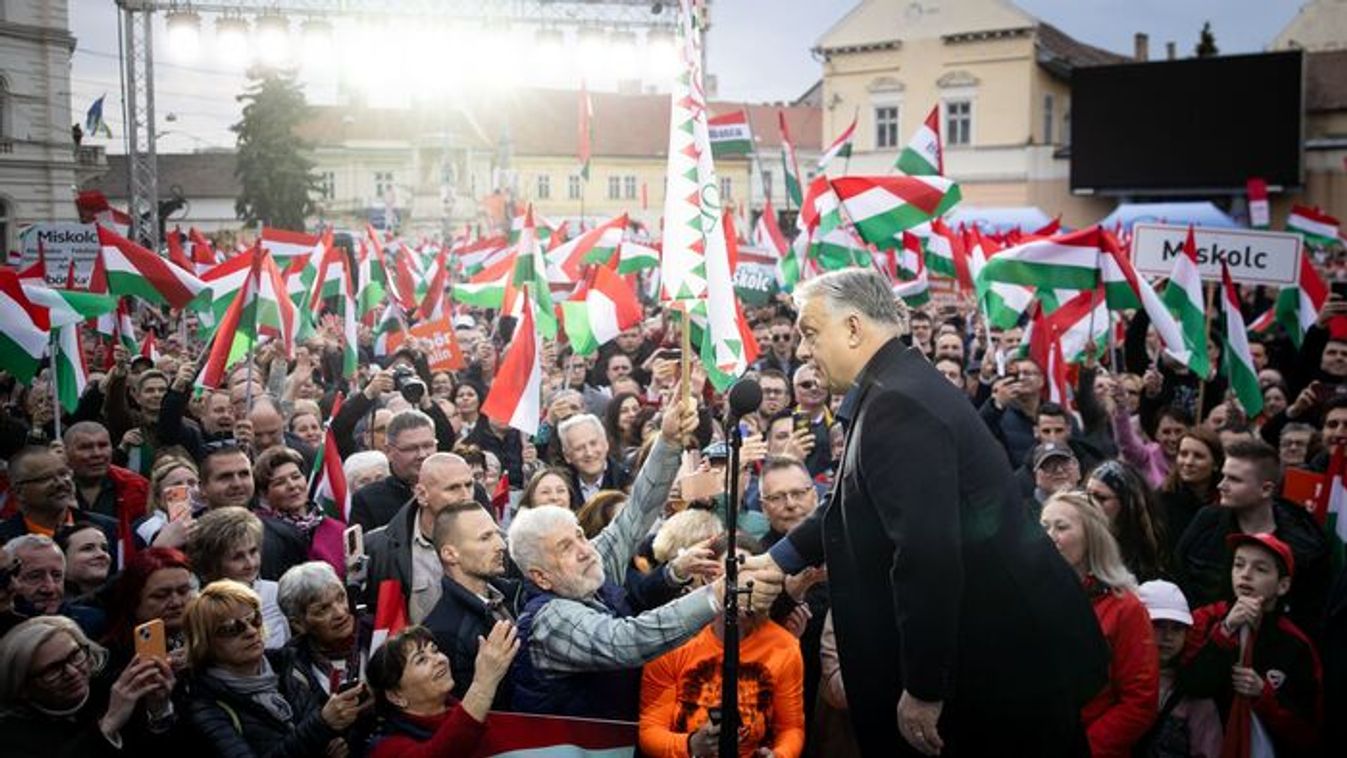
Since the Peace March on the national holiday of March 15, the right has visibly surged forward and now appears unstoppable. After the show of strength in the capital, Viktor Orban delivered campaign speeches across several rural towns, drawing large crowds everywhere he went.

Large crowds have turned out to hear the prime minister in person, filling to capacity the mains squares in Miskolc, Szentendre, Eger, Kaposvar and Dunaujvaros.
By contrast, Peter Magyar’s events in the countryside show a far more modest picture.
For months, footage has circulated showing only a few dozen attendees at his forums, many of whom may have been organized party activists. At several locations, it was also noted that the number of parked cars exceeded the number of participants.
Trouble in the control tower: Peter Magyar’s team now handing out bananas in rural areas
Tisza Party in a difficult position. In recent days, they have attempted to explain the glaring disparity from multiple angles. Claims have emerged suggesting that large crowds at pro-government events are driven by various incentives. Peter Magyar spoke about the distribution of 110,000 sacks of potatoes and onions. Later, another narrative appeared, alleging that Asians were being transported to government events.
Peter Magyar specifically claimed that many “Asian colleagues” (?) appeared in Dobo Square in Eger before Viktor Orban’s speech.
Orban dismissed these accusations, saying:
There is trouble in the tower on the other side. They are feeling the winds of defeat now that Hungarians have stepped forward.
But that is not all: Peter Magyar and his team have since reportedly been caught handing out bananas to voters in Nograd County, effectively doing the very thing they accused the other side of.
Growing numbers on the right are openly expressing their views
A few days ago, Zoltan Lomnici Jr. from Szazadveg Foundation told Magyar Nemzet that public discourse has grown increasingly aggressive in recent times, which may have discouraged right-wing voters from openly expressing their views.
The Peace March, however, gave the patriotic community an opportunity to express its position safely and in large numbers, potentially restoring the voice of those who previously felt sidelined.
According to Mr Lomnici, the inability of Peter Magyar’s camp to mobilize large crowds in rural areas highlights the limitations of the Tisza Party. He argues that the party is more of a big-city, social media–driven phenomenon, while Fidesz maintains a stable base in the countryside.
The expert also noted that opinion polls should be treated with caution, as real political strength is often demonstrated through mobilization.
As an example, he pointed to the 2024 US presidential election, where despite polling expectations, Donald Trump ultimately secured a major victory over Kamala Harris.


Szóljon hozzá!
Jelenleg csak a hozzászólások egy kis részét látja. Hozzászóláshoz és a további kommentek megtekintéséhez lépjen be, vagy regisztráljon!