PM Orban: We Should Pray Not Only Before Making Decisions

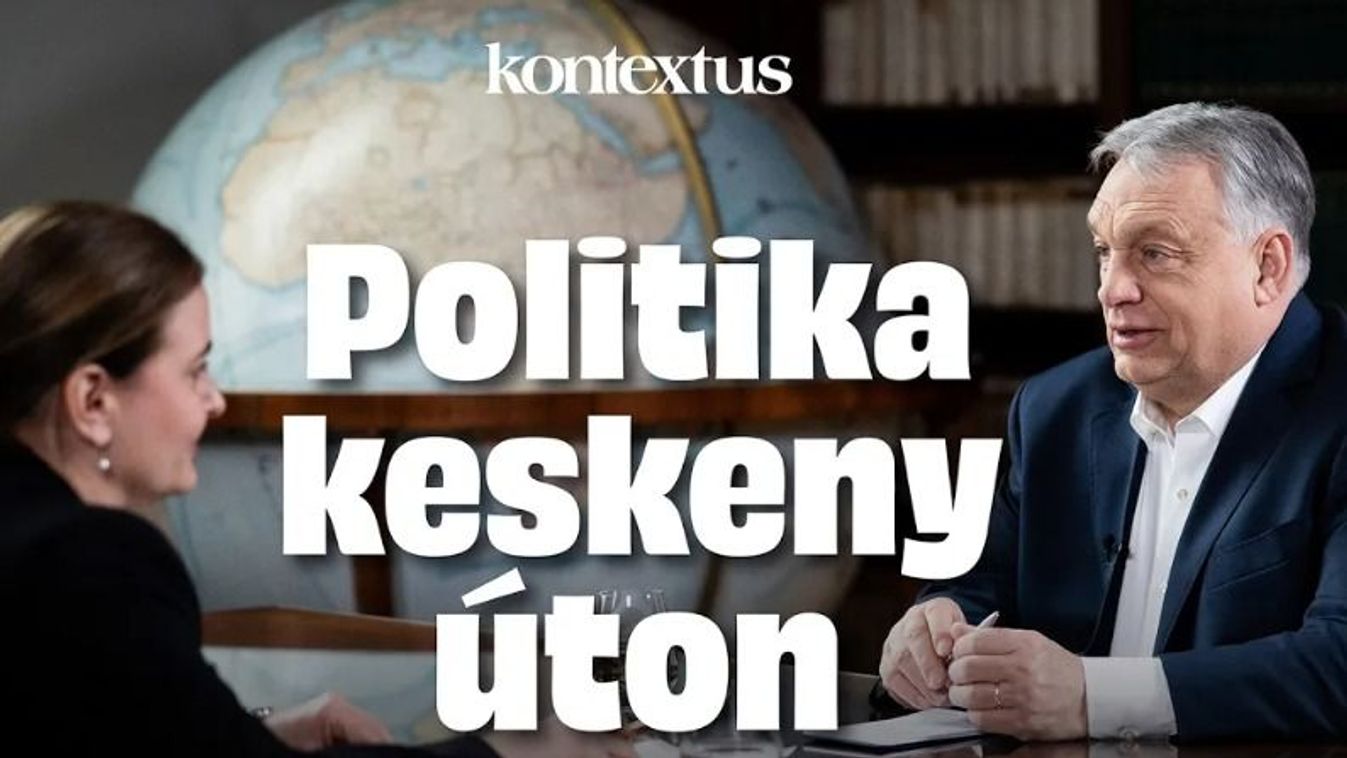
Zsuzsa Mathe, head of the Saint Stephen Institute, interviewed Prime Minister Viktor Orban on Good Friday. The conversation was published on the YouTube channel Kontextus.

2026. 04. 03. 13:07
VéleményhírlevélJobban mondva - heti véleményhírlevél - ahol a hét kiemelt témáihoz fűzött személyes gondolatok összeérnek, részletek itt.

Zsuzsa Mathe, head of the Saint Stephen Institute, interviewed Prime Minister Viktor Orban on Good Friday. The prime minister began by saying that

we are living in a special moment, because it is not only Holy Week, but also a campaign period.

He admitted that this creates difficulties for him, as every minute counts during a campaign, while Easter is about quiet reflection, contemplation, then resurrection and joy, which does not fit easily with the intensity of an election campaign.

“Is it allowed, for example, to hold a campaign event on Holy Thursday?” asked the prime minister, who traveled to Szombathely the day before, where a large crowd had gathered to hear him. “That's still possible, then we'll finish it tonight.  fits, but by the evening. Now Good Friday can begin, with quietude taking over,” he said.

Zsuzsa Mathe asked about the warning of Pope Benedict XVI. According to Viktor Orban, this is the essence of politics as well: we must be able to distinguish between good and evil, but for that, we need a standard by which we can determine what is good and what is bad.

He said there is a struggle between a liberal and a Christian worldview. Liberals, he argued, believe there is no absolute good or evil, and therefore everything is relative, open to interpretation from different perspectives, making common agreement on good and evil nearly impossible. Christians, on the other hand, believe there is a teaching that helps us identify what is good and what is bad, and that we must follow the good and reject the bad.

“This rarely happens in European politics, such debates are banned. If one brings the Bible or religious teachings into political discourse, one can expect censorship from platforms like Meta or other “content checkers. Such approaches are typically rejected in European political debates as well. Hungary is somewhat different. I am not saying that the situation here is very good, but it is much better than in most Western European countries,” he explained.  

 “We should pray not only before making decisions, prayer has its place and time, and it should be practiced regularly,”

Viktor Orban said, adding that "aside from occasional lapses, I follow this practice myself," in response to the question of whether he usually prays before making big decisions.

The interviewer also mentioned that Viktor Orban had received an award from Pope John Paul II, and according to legend, the Holy Father told him it was not for what he had done, but for what he would do. Viktor Orban responded that he is not entirely sure this should be attributed to the Pope, but that the statement is nevertheless true.

He said he has always viewed this and his life in general as forward-looking: while it is sometimes useful to reflect on past experience, what truly matters is what lies ahead. "And perhaps it is still permissible to say at my age that awards are not some kind of gesture of career or service closure, but they are more like encouragement since I still have energy to continue," he said.

Viktor Orban said the cooperation between Fidesz and the Christian Democrats (KDNP) is a uniquely Hungarian answer to a challenge that has proven fatal for many parties in Europe. He explained that Christians must represent the truth as derived from their teachings, while also securing the majority needed to govern. In today’s European politics, he argued, this is no longer possible within a single party. Therefore, in Hungary, the KDNP does not focus on gathering votes, but instead serves as an anchor in governance.

“If someone looks at Hungary’s Fundamental Law, they can rightly say that it is indeed a Christian and national constitution, and this is thanks to the political alliance represented by Fidesz and KDNP,” the prime minister noted.

On the relationship between the state and the church, he emphasized that they operate separately, but a right-wing government supports the work of churches, while the left seeks to push them back. “For them, the church is an enemy,” he said.

He described the debate about the merging of church and state as a “foolish debate,” arguing that cooperation between them for shared goals is well-regulated, morally grounded, and politically and practically sound.

Viktor Orban pointed out that churches were suppressed for 40 years under communism, followed by 20 chaotic years after 1990 when liberals continued to attack them. He said the past 20 years have been different: churches now feel not only that they receive what is due to them, but that they are respected, recognized, and valued by public authority. He added that the government also values church leaders personally.

On migration, he said that

 "I expected strong Catholic criticism of Hungary’s migration policy, but this did not materialize."

Speaking about war, the prime minister said it is absurd that on a Christian continent one must explain why they stand for peace, while those who support war and bloodshed attempt to morally criticize those who stand for human life.

Europe: a cut flower

Viktor Orban noted that the relationship between Christianity and Europe has changed radically compared to previous centuries. “Today’s European civilization is like a cut flower,” he said. “It is still rich, although, money, capital and reserves are running out. The flower in the vase is colorful, still magnificent, you can still use some salt or plant nutrient or something that replaces the mother earth, you can still prolong its life, but it has been cut off from the soil from where this richness, magnificence, and color comes.”

“Cutting Western societies off from their Christian foundations will have tragic consequences—indeed, already has. The system will collapse there, and there will be very serious cultural and anthropological damage in Western Europe when the elements of Christian culture and Christian tradition relating to families also change,” he predicted.

He said Europe’s current dead end is partly due to decision-makers who, at key moments, had a different time horizon. “My time horizon is different,” he said. “When I make decisions, I think of my children and grandchildren and I place every decision into a perspective of decades.”

At the end of the interview, the relationship among Hungary’s churches was discussed. Viktor Orban said that Hungary avoided civil war, unlike many other countries. “Sometimes such denominational tensions flare up from unexpected places, but I will also give a positive example. Bishop Gusztav Bolcskei of the Reformed Church is somebody you could have good discussions with because you didn't have to agree with him on everything, and I will always be grateful to him for this also as prime minister. The bishop was invited when Peter Erdo was installed as Cardinal in Esztergom, which praises the Catholics. Bishop Gusztav Bolcskei attended the installation ceremony, which is one of his historic deeds, and gave a speech that remains to this day a guiding compass for all members of the Reformed Church on how to live together with our Catholic brothers and sisters,” Viktor Orban recalled.

Finally, the interviewer asked how the nation can reconcile the day after the election on April 13.

“A Catholic brother of ours, whom we recently buried, taught us that Christianity is not theory but practice. As Christians, we must accept the result of the election—whether it is favorable or unfavorable,” Viktor Orban responded.

Komment

Összesen 0 komment

A kommentek nem szerkesztett tartalmak, tartalmuk a szerzőjük álláspontját tükrözi. Mielőtt hozzászólna, kérjük, olvassa el a kommentszabályzatot.


Jelenleg nincsenek kommentek.

Szóljon hozzá!

Jelenleg csak a hozzászólások egy kis részét látja. Hozzászóláshoz és a további kommentek megtekintéséhez lépjen be, vagy regisztráljon!

A téma legfrissebb hírei

Tovább az összes cikkhez chevron-right

Ne maradjon le a Magyar Nemzet legjobb írásairól, olvassa őket minden nap!

Google News
A legfrissebb hírekért kövess minket az Magyar Nemzet Google News oldalán is!

Címoldalról ajánljuk

Tovább az összes cikkhez chevron-right

Portfóliónk minőségi tartalmat jelent minden olvasó számára. Egyedülálló elérést, országos lefedettséget és változatos megjelenési lehetőséget biztosít. Folyamatosan keressük az új irányokat és fejlődési lehetőségeket. Ez jövőnk záloga.