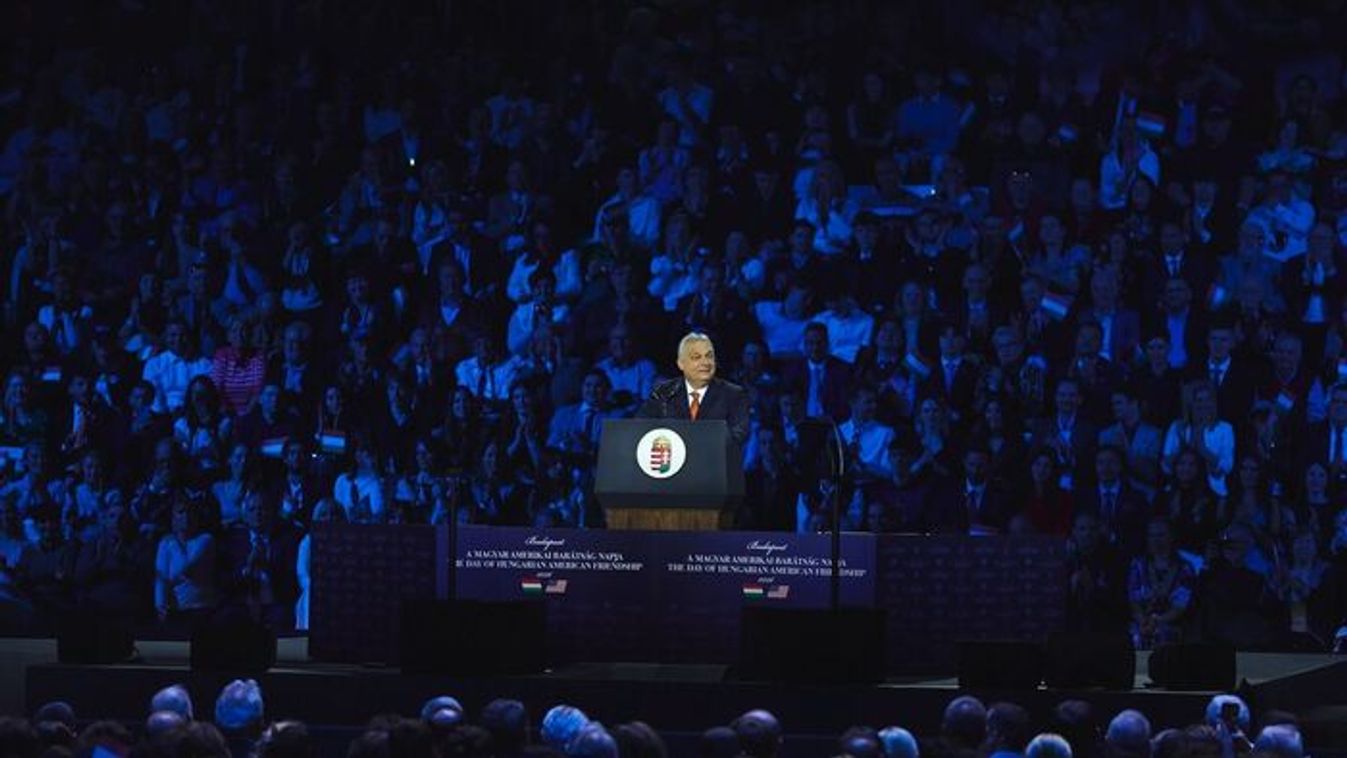
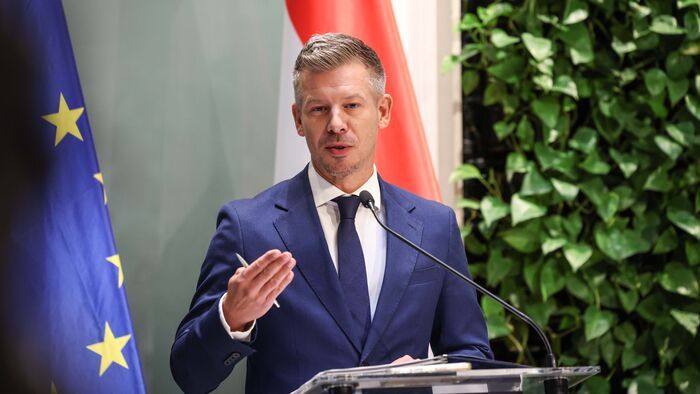
"Faceless bureaucrats in Brussels and foreign countries want to dictate how Hungarians should live. Don’t let them!" In a week’s time, Hungarians will have to make a choice: either bow down to tyranny, or following in the footsteps of King Saint Stephen, elect a true leader for themselves this weekend. "My friends, go out and vote this weekend. Stand with Viktor Orban, because he stands up for you," said US Vice President J. D. Vance at a rally in Budapest, where Viktor Orban also addressed the crowd.
In his introduction, Philip Rakay described the Hungarian prime minister as a politician active for nearly forty years, who already in the late 1980s, before the fall of the Iron Curtain, dreamed of a free, sovereign Hungary free from Soviet influence, and who did much to bring about the regime change in 1990. He added that
since then, he has served five terms, totaling twenty years as prime minister, and is “a true patriot” whose political mission, illiberal thinking against the globalist mainstream, and bold political vision are increasingly seen worldwide as an example to follow. He also highlighted the growing influence of the Patriots for Europe alliance launched by him.
He recalled that ten years ago, in the summer of 2016, he was the only EU prime minister to stand by Donald Trump’s policies, and by now has become one of the American president’s most important allies. This led, as he put it, to a “golden age” in Hungarian-American relations.
Finally, he turned to the audience and announced: “The Prime Minister of Hungary, Viktor Orban.”
At the beginning of his speech, Viktor Orban greeted the US vice president, the American guests, and the audience, emphasizing that “we welcome the Vice President of the United States in Hungary with respect and appreciation.”
He thanked the audience for accepting the invitation and highlighted that “we can celebrate together the Day of Hungarian-American Friendship.” He said that they are grateful to providence that “such a great and powerful bald eagle can be our friend. I report that the eagle has landed in Hungary,” Viktor Orban sad, adding that “the ancient bird of the Hungarians, the Turul, has welcomed it in friendship.”
He stressed that “such a shared day has never occurred in the history of our nations,” and emphasized that “we are not simply at a diplomatic event,” but rather celebrating “the meeting of the struggles and hopes of two nations,” as well as “the golden age of Hungarian-American relations.” He added that the political and business benefits of this golden age “are not the cause, but the consequence.”
The prime minister highlighted that Hungarian-American friendship “is in fact civilizational and spiritual in nature,” and stated that “today two freedom-loving nations meet.” He recalled that the United States is “a country born in a war of independence,” which “fought a global empire in order to be free,” noting that “you built a great country for yourselves, and it only took 250 years.”
God bless the United States on its 250th birthday!
he said.
“Who could love freedom more than the Hungarians?” Viktor Orban asked, emphasizing that “there is no other nation in Europe that more empires have tried to dominate than Hungary.” He added that “we have taken up the fight against every oppressive power of every era, and whether with sword and blood or with persistent work, we have fought against every empire.”
He stated that although “we did not win all our wars of independence, throughout our 1,100-year history we have never fought in vain, because the conquerors have fallen, and the Hungarians have remained,” he said, adding that “we are alive and thriving.” He stressed that “everything is in place for us to be the winners of the coming century,” and declared: “I believe—we believe—that this will be the century of the Hungarians.”
The Hungarian prime minister also noted that there is a great distance between America and Hungary, as “an ocean separates us, yet the freedom struggles of the two nations are connected.” As an example, he mentioned that “in the American War of Independence, hussar officer Mihaly Kovats organized the cavalry of the Continental Army, and that Lajos Kossuth was also celebrated in America.”
He recalled that after the First World War, “foreign looting troops occupied our homeland,” and an American general personally defended the Hungarian National Museum, preventing the treasures of the Hungarian nation from being lost. He added that “the statue of that general still stands today on Szabadsag Square.”
He emphasized that Hungarians “honor Ronald Reagan as a hero, who decided to win the Cold War and free the peoples from Soviet rule, and not only decided, but also acted,” making it possible for Hungary to “return to the free nations of the Western world.” He stated: “Glory to Ronald Reagan.”
Turning to the US vice president, Viktor Orban said that “Bartok, Teller, Neumann, Kertesz, Cukor, Pulitzer, and others were people who longed for freedom and therefore found a home in the New World.” He added that “they became successful there, bringingt glory to both their new and old homelands.”
Recalling personal memories, he said that “President Bush played a decisive role in allowing us to end communism and send the Soviet troops home,” adding that in 1989 he not only visited Budapest but made the reburial of the victims of the 1956 revolution a condition, which “led us to the restoration of freedom and democracy.”
Viktor Orban stated that Hungarian-American friendship “even survived those difficult years when American Democrats wanted to reshape thousand-year-old Christian Hungary into a progressive left-wing country.” He emphasized:
A freedom-loving people cannot be defeated in the name of liberal ideology,
adding that “we are still here and they are gone, and Hungarian-American friendship once again shines in its former glory.”
He highlighted that this turning point in relations is thanks to President Donald Trump, who “put an end to the dominance of the global elite ruling in the name of ideologies and announced the era of strong nations.” He said Donald Trump “awakened and mobilized patriots around the world with a simple sentence: ‘Patriotism is not a sin, but a virtue.’”
He added that the American president “demonstrated that patriotic politics is not a slogan, but a successful governing practice, as America once again put its own interests first, restoring the honor of national politics.” He emphasized that “his economic patriotism protected jobs and brought industry back home, proving that globalization is not destiny.”
On migration, he said Trump “declared war on illegal migration and revived the old principle: ‘without borders there is no country, without sovereignty there is no freedom.’” He added that “we have every reason to send our heartfelt fraternal greetings from Budapest.”
“President Trump’s success sends a message to Europe as well: the national interest does not isolate, it strengthens,” Viktor Orban said, emphasizing that “we will not allow others to decide our fate, we will carry out our own plans.”
He said that “we have been waiting for this moment since 2010,” and that “it was extremely difficult to fight both the Brussels and Washington progressives at the same time. Your victory, Mr. Vice President, was like resuscitation.” He pointed out that “while Europe was still shocked, we had already laid the foundations of our cooperation, because in politics, alongside courage, timing is the most important.”
Viktor Orban remarked that “even taking offense must be done wisely,” adding that “you should not take offense when you have reason to, but when it is worthwhile.” He noted that “investment with the United States is once again visa-free,” and emphasized cooperation in the economy, defense, high technology, and innovation, as well as joint programs in the field of energy. “Two sovereign nations are working together to make the world a better place for their peoples, based on a shared love of freedom,”
he stated.
He highlighted that “in the person of the vice president, we have gained a special friend,” adding that “Hungarians are not easy to understand, because we are an ancient nation, and like Americans, we consider ourselves exceptional.” He remarked that “if they do not understand us, that is their problem,” noting that “we even cling to our faults.” Still, he added, “the vice president handles all this well.”
He recalled that J. D. Vance had previously warned about the dangers of progressive liberalism, quoting him: “Europe is threatened from within; it will not be defeated by an external enemy, but brought to its knees from within.” He added that this “liberated intellectual and political forces” previously constrained by political correctness.
According to the prime minister, the vice president recognizes “when outsiders attempt to interfere in elections,” and warned that “they are interfering here as well, and have done so elsewhere,” adding that “we are watching too.”
He said another key idea of the vice president is that “the progressive system binds people, restrains performance, and attacks the values that once made our nations great.” He emphasized that “this is the foundation of our friendship,” adding that
it is fitting and right that we should celebrate the day of friendship between our nations together today.
Viktor Orban stated that Americans and Hungarians concerned about the future of Western civilization “share a common problem,” which is called Brussels. He said progressive forces “lost two major battles” and then “retreated to Brussels,” where “they still hold significant power.”
He criticized European politics, saying: “Brussels wants to make gender ideology, woke madness, and migration the organizing forces of Europe,” while “persecuting its political opponents.” He added that “clear and obvious violations of law are being carried out against patriots,” accompanied by “financial isolation and harassment from secret services.”
Regarding the war and energy situation, he said: “they still want to continue the war in Ukraine, and support Ukraine to the very end,” and instead of achieving peace they impose more and more sanctions. "This is more than irresponsibility—it amounts to suicide,” he stressed, because “if this continues, energy prices will first skyrocket, and then European reserves will be depleted.”
He added that “Brussels does not represent us, but is colluding with the Ukrainians,” and emphasized that “we are being punished because we pointed to Brussels’ self-destructive policies.”
In closing, he warned that “the years ahead will not be easy, as Europe is simultaneously threatened by financial and energy crises.” If Europe does not change course quickly, it will lose on both fronts, he warned.
Végül hangsúlyozta: „nekünk, szabadságszerető amerikaiaknak és magyaroknak össze kell fognunk”, „meg kell mentenünk a nyugati civilizációt”, ehhez pedig
Finally, he emphasized: “we, freedom-loving Americans and Hungarians, must stand together. We must save Western civilization,” and to do so,
we must confront the progressives entrenched in Brussels, bring the Russia-Ukraine war to an end, and resolve the energy crisis.
Trump sent a message by phone: “I love Hungary very much”
In his introduction, Philip Rakay said: “Ladies and gentlemen, next we welcome one of the youngest vice presidents in the history of the United States—and the 50th in line—J. D. Vance.”
J. D. Vance then took the stage and placed a phone call to Donald Trump. Turning to the audience, he said: “I would like to call a special guest, let’s see if he answer.” The call went through successfully. From the other end of the line, Trump said: “I love Hungary very much,” and added, “He is a fantastic man, we have a great relationship, and he is doing an excellent job.”
Speaking about Viktor Orban, the American president emphasized: “He has stood in the way of anyone trying to take over your country, he has preserved your nation, and he has done a tremendous job.” He added: “I like him very much.” President Trump also greeted the crowd, saying: “I greet this wonderful audience,” and “you are great people, you have held firmly onto your homeland.” He stressed that Hungarians do not have to face many of the problems that other countries do, because “you did not allow your country to be taken over.”
At the end of the conversation, Donald Trump said: “I am such a big supporter of Viktor Orban,” and added: “My warmest greetings to everyone.”
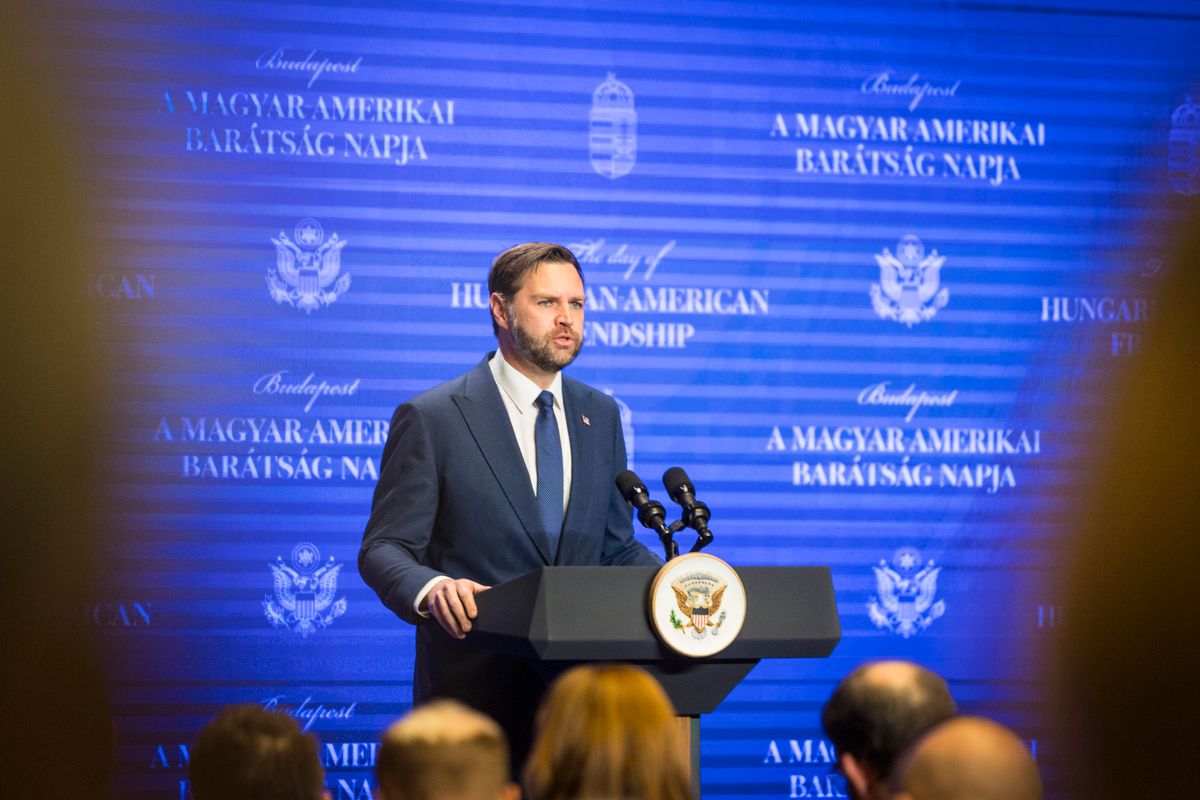
US Vice President J. D. Vance in Budapest (Photo: Prime Minister’s General Department of Communication)
Vance: Hungary is a frontline defender of sovereignty and freedom
Úgy fogalmazott: „arra törekszünk, hogy Orbán Viktort újraválasszuk, igaz?” After the phone call, J. D. Vance reacted: “Wow! It’s hard to speak after that, but I’ll try to do my best.” He asked: “We are working to re-elect Viktor Orban, right?”
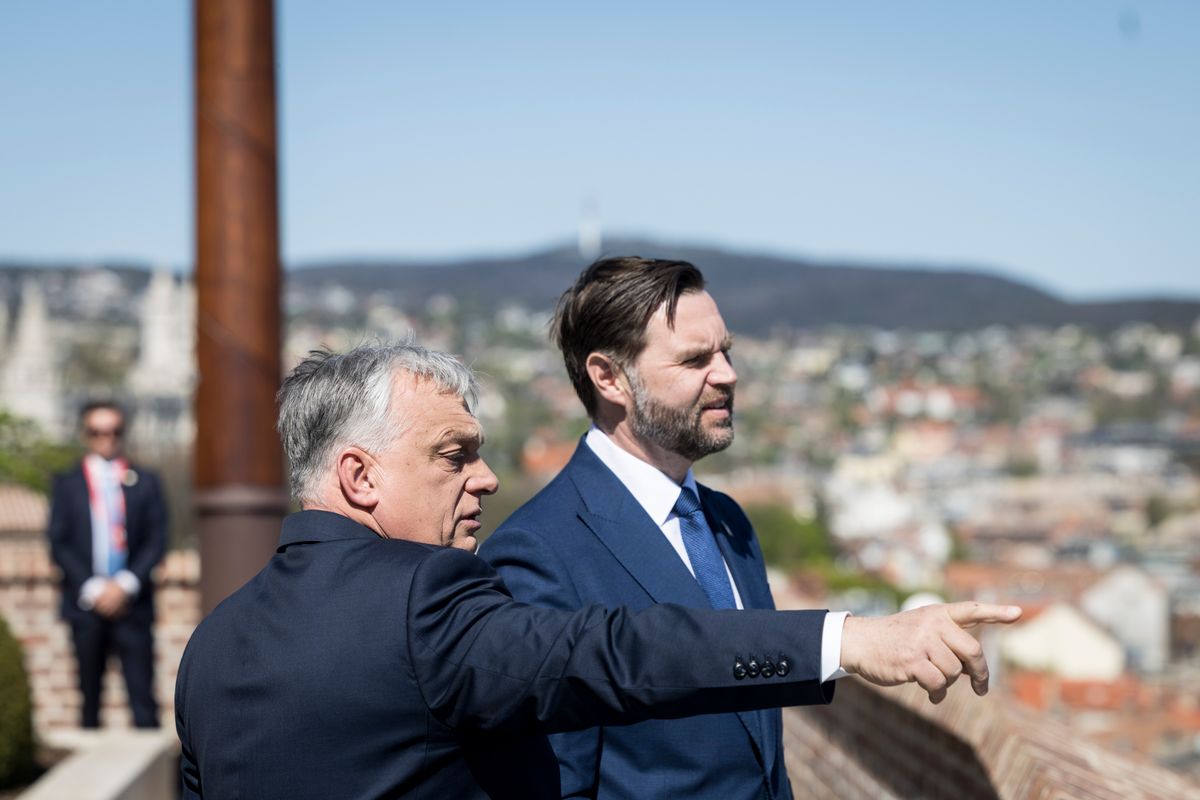
The vice president noted that this was his second visit to Budapest, but the first time he had come as a public office holder. He recalled that during his previous visit, “the current Second Lady was pregnant with our second child,” while now “my wife is carrying our fourth child.”
He added, jokingly, that during official meetings he asked Viktor Orban: “Can we get some of those generous family benefits you have here in Hungary?”To which, according to Vance, the prime minister replied: “Unfortunately, Mr. Vice President, those are only for Hungarians.”
In his speech, Vance said: “What a journey we have already been on,” adding that “Budapest is a wonderful place,” built by “your ancestors” and crowned with “a remarkable architectural heritage.” He emphasized that relations between the United States and Hungary are opening new horizons, particularly in energy security, business, and trade. “Thank you for your hospitality,” he said, “and thank you for being such great friends of the United States.”
The vice president stated: “I want to speak to every Hungarian man and woman,” from the elderly to the young, “from every generation and every background. I am here because I admire your struggle,” he said, “because you are fighting for your freedom and your sovereignty.” He went on to add that “President Trump and myself wholeheartedly wish you success in this fight.”
He stressed: “We want nothing more than to be your allies, and to stand together with all those who resist those trying to push Hungary down and oppress it. Hungary has always been at the forefront of these struggles,” he said, adding: “In Hungary, Hungary comes first.”
The American vice president emphasized: “We admire you,” and want Hungarians “to decide your own future without outside interference. I do not want to tell you who to vote for,” he said, but added that people should not listen to “Brussels euro-bureaucrats,” but instead listen “to your hearts, your souls, and the sovereignty of the Hungarian people.”
“I am not here to threaten you or blackmail you by withholding funds,” he continued, “I have come in the spirit of friendship.” He stressed that Hungarians have “boldly and courageously represented Western civilization,” and that “Viktor Orban has given the Hungarian nation a reason to be proud.”
Left-wing ideologies and Brussels threaten Europe’s future
Vance also warned that “volume and courage attract critics,” and cautioned against what he described as “far-left thinking,” which, in his words, “has taken over our universities” and “sees nothing but injustice in Western societies.” He said these movements “see exclusion in our borders and oppression in the family,” adding that “the most radical among them tear down statues of national heroes, vandalize monuments, and burn churches.”
He emphasized that “we must protect our borders,” because “if chaos and violence take over our streets, it is the most vulnerable who will suffer.” He also criticized those who “call themselves feminists,” arguing that “the ideas they promote actually put women at risk.”
“We are fighting this battle because we do not want the most vulnerable members of our society to be unable to heat their homes,” J. D. Vance said, adding: “Our opponents claim to care about corruption, yet they turn a blind eye to corruption in Brussels,” and criticized “those same euro-bureaucrats” whose actions, he argued, “are putting the future of this beautiful continent at risk.”
He pointed out that “the European press is trying to scare people,” claiming that “Trump wants to take over Europe,” but emphasized: “We love Europe. How could we not?” he said. “The United States was born out of this continent.” He added: “We love its people, its cultures, and its incredible history.”
According to the vice president, this is precisely why “we reject faceless bureaucrats” who “drive energy prices sky-high in the name of progress.” He added: “I see real progress in Hungary under Viktor Orban’s leadership.”
J. D. Vance said, “I see a trade partner” that “has been able to attract record-breaking American investment to Hungary,” and emphasized, “I see clean streets” where “people can live in safety.” He emphasized: “I see workplaces where patriotism can be expressed, rather than hatred for one’s country.”
Then he said, “Here I can clearly see what the Eurocrats are hiding from you,” and pointed out, “In almost every country in Europe, energy costs more than in Hungary.”
J. D. Vance praise the policies pursued by Viktor Orban (Photo: Prime Minister’s General Department of Communication)
Europe’s future depends on sovereignty and the protection of Christian values
Speaking about energy security, J. D. Vance said that “the reason for this is that Viktor Orban fought for energy security, while most European leaders did not.” He added that “most European leaders sneer at the God-fearing Hungarian people,” and criticized the fact that
the United States and Hungary are condemned simply because we want low energy costs.
He emphasized: “We are condemned simply because we want to bring the war between Russia and Ukraine to an end as soon as possible.” “They look down on us,” he said, “and they look down on those European nations that want to keep migration under control.” “They hate our border protection, they hate energy independence,” he continued, adding: “And above all, there is one man they hate the most—Viktor Orban—which means Viktor Orban is on your side.”
He added:“They hate Viktor because he stands up for the Hungarian people,” and stressed that “President Trump stands for Europe, for sovereignty, and for Hungary,” and that “we stand shoulder to shoulder with the man who has fought the hardest for our shared values—Viktor Orban.”
Speaking about European civilization, J. D. Vance said: “The leaders of this country may understand better than anyone else what the essence of European civilization truly is,” and warned: “This civilization cannot sustain itself. We must act for it, we must protect it,” he emphasized, adding: “Patriotism is not a problem, and a strong nation-state is not a problem but it is a necessary part of this struggle.”
“There is certainly an alternative, and you can see it right here in Hungary,” he added, stressing that “if Hungary can secure its borders, others could do the same—and if they do not, that is the result of a decision.” He made a similar point about the economy: “If Hungary can prioritize its own workers, other nations could do the same, and if they do not, that too is a choice.”
He argued that “Viktor Orban’s leadership has become a target for euro-bureaucrats,” because “they know that true sovereignty is possible,” and that “it is possible to pursue a policy that is pro-Europe, pro-America, and pro-nation at the same time.”
Speaking about the protection of ideas, he emphasized that “we are not only defending our own people, but also the ideas that made our civilization flourish.” He said: “It is the self-sacrificial love of Jesus Christ that allowed our civilization to flourish,” which “was built on the law of Moses and Roman law,” and “created the most tolerant and most prosperous societies.”
“Fundamental human rights, love of neighbor, and the protection of the weak are all ideas that brought humanity closer to human dignity,” and that these ideas “are rooted in Holy Scripture,” he added. At the same time, he warned: “Not every society shares these values,” because “civilization may be universally true, but it is not universally accepted.”
“It is easy, in a picturesque landscape, to take these values for granted—but every bridge and every building is the result of generations of hard work,” he emphasized.
What is at stake: preserving civilization and sovereignty
Speaking about the defense of values, J. D. Vance noted: “What generations have built through hard work can be destroyed within a single lifetime, therefore, we must protect our values.” He added: “You understand exactly what is at stake,” and emphasized that “Hungary is a nation that has repeatedly defeated those who threatened its sovereignty.”
“That is what makes the Hungarian people so unique and remarkable,” he said, recalling that Hungarians “successfully freed themselves from the nightmare of communism.” He added: “When the communists came to power, they dismantled every institution that made this nation great, they rewrote history, they destroyed churches, and they introduced the policy of salami tactics.” He went on to emphasize: “But thank God, the spirit of King Saint Stephen ultimately prevailed.”
Turning to present-day challenges, he said: “I want to ask you something very simple. Let us renew this spirit together.” However, he warned: “Sovereignty is once again under threat in Hungary, because bureaucrats once again want to dictate.” “But you have a choice before you: will you bow to tyranny, or will you follow King Saint Stephen?”
He said: “We are talking about a true leader,” one who “understands your pride,” and “fights to preserve these values while building a better future. This is far more important than party labels or political designations,” he added.
According to J. D. Vance, “in the West, a small radical group no longer believes in our future—yet they want to govern us.” He posed the question: “If they do not believe in our future, why do they want to dictate policy to us?”“They do not want to build the future,” he said, “they want to manage decline.”
He stressed that these movements: “reject fatherhood and motherhood, would mutilate children in the name of gender programs, and would institutionalize killing in the name of end-of-life planning.” He added that “they would also use social media tools for censorship.”
It is our sacred duty to protect life,” and “our duty to protect what generations have built through hard work.”
J. D. Vance stated: “We must build a life that is affordable for our citizens,” and emphasized:“If we are committed to the flourishing of society, then we are committed to life itself.”“That is why I am here,” he said, adding:“President Trump sent me here to stand with Viktor Orban.”
Shared roots, shared future in the spirit of sovereignty
“I believe that when our nations stand together, they are capable of great things,” and stressed that “our work is not a zero-sum game, because we must strive to provide a better life for our peoples.” He stated: “Bureaucrats say the choice is between isolation and globalist migration,” but in his view, “there is a better path: cooperation among nations that share common values.”
Speaking about U.S.-Hungarian relations, he emphasized that “this is the story of a much longer friendship,” and recalled that “Mihaly Kovats, a Hungarian soldier, helped establish the first American cavalry unit,” and “gave his life fighting against the British Empire.” He added that “Lajos Kossuth was welcomed in the United States like a rock star,” and “even delivered a speech before Congress.
According to J. D. Vance, all of this shows that “our nations did not see something radically different in one another,” but rather that “the same forces were at work in both America and Hungary.” As he put it: “We create values out of the wilderness through our convictions, and that is the West.” At the conclusion of his speech, he stated:
It was true then, and it is true now, that the United States was the cradle of a new civilization, a reborn humanity.
J. D. Vance said that “America, just like Hungary, is not merely about comfort,” but is “built around the idea of creation and renewal.” He emphasized: “American and Hungarian heroes took the shaping of the future into their own hands,” and “they passed this mindset on to their children and grandchildren.”
Referring to Lajos Kossuth, he said: “America will be the cornerstone of national independence on the American continent, and Hungary on the European continent,” and added: “In 2026, even today, this prophecy still holds true.”
Speaking about Viktor Orban’s leadership, he said:
Under Viktor Orban’s leadership, you have preserved those civilizational goods that make life worth living,”
and listed them as: “sovereignty, prosperity, history, a sense of national unity, and the value of building new families.”
He emphasized that “in much of the West, uncertainty is growing,” but “here, there is no such uncertainty,” because “you have stood up against bureaucrats and nihilists.” He then addressed the audience directly with a series of questions: “Will you once again stand up to the bureaucrats?” “Will you stand for sovereignty and democracy?” “And will you stand for Western civilization, for freedom, for truth, and for the God of our fathers?”
At the end of his speech, he called on the audience: “Go to the polls and stand with Viktor Orban, because he stands with you.” He closed with the words: “God bless Hungary, and God bless the United States of America.”
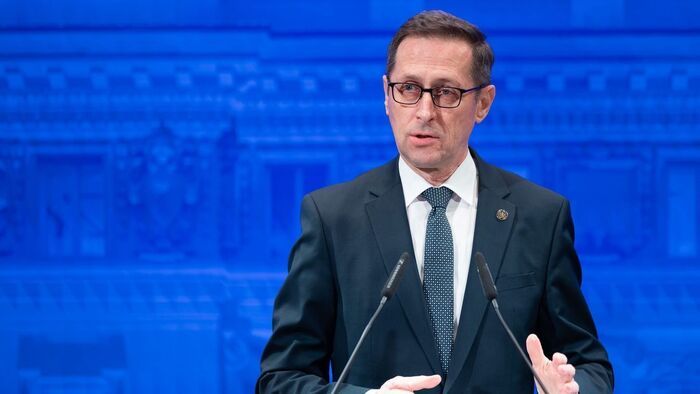
Cover photo: Hungarian Prime Minister Viktor Orban (Photo: David Balogh)
A Magyar Nemzet konzervatív, nemzeti-kulturális hetilap, amely nemcsak híreket közöl, hanem értelmezi is a világot. Hiteles szerzőkkel, mélyebb összefüggésekkel és időtálló gondolatokkal segít eligazodni a közélet, a kultúra, a történelem és a mindennapi élet kérdéseiben.
Milliószor odakozmált szakértők győzködik arról a nagyérdeműt, hogy ő jár majd jól azzal, ha eltörlik a rezsicsökkentést és mindenki sokkal többet fizethet a gázért, a villanyért meg a vízért annál, mint amennyit most fizet.
A Magyar Nemzet konzervatív, nemzeti-kulturális hetilap, amely nemcsak híreket közöl, hanem értelmezi is a világot. Hiteles szerzőkkel, mélyebb összefüggésekkel és időtálló gondolatokkal segít eligazodni a közélet, a kultúra, a történelem és a mindennapi élet kérdéseiben.
Portfóliónk minőségi tartalmat jelent minden olvasó számára. Egyedülálló elérést, országos lefedettséget és változatos megjelenési lehetőséget biztosít. Folyamatosan keressük az új irányokat és fejlődési lehetőségeket. Ez jövőnk záloga.