Brussels Wants War, Hungary Wants Peace

Prime Minister Viktor Orban spoke to Magyar Nemzet in a Christmas interview.

2025. 12. 24. 14:05
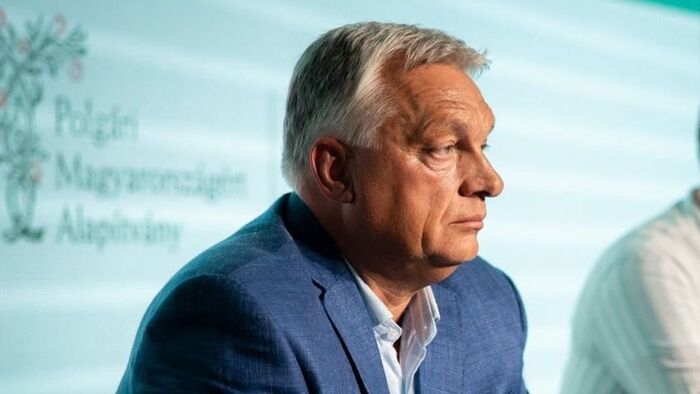
Hungarian Prime Minister Viktor Orban (Photo: Prime Minister's General Department of Communication/Zoltan Fischer)
VéleményhírlevélJobban mondva - heti véleményhírlevél - ahol a hét kiemelt témáihoz fűzött személyes gondolatok összeérnek, részletek itt.

Prime Minister, do you think it is possible that 2025 was the last year of peace for Europe?
Yes, that cannot be ruled out.

The very fact that this question can even arise is shocking.
We have grown accustomed to peace. The last major European war ended in 1945, and eighty years have passed since then. That is an extremely rare condition in Europe. For a long time, nuclear weapons of mass destruction restrained the nations of the continent from war. Everyone assumed that a European conflict would inevitably escalate into a nuclear world war. That fear worked for eighty years. But now an entirely new world is emerging.

A redistribution of financial, military, and political power is underway, which can ignite war. The war tension palpable in Europe is a consequence of the decline of Western Europe and the European Union.

You returned from the EU summit in Brussels a few days ago. Are we closer to peace or farther away from it?
We have moved closer to war. Last week in Brussels, all we managed to achieve was to slow the pace at which Europe is drifting into war. Some wanted to accelerate this process to hyper speed, and we succeeded in blocking them. However, the process itself has not stopped. We only prevented its acceleration. Today, there are once again two camps in Europe: a war camp and a peace camp. At the moment, pro-war forces are prevalent. Brussels wants war. Hungary wants peace.

It feels like a Chekhovian situation: weapons keep appearing on the European stage. Rearmament, conscription, preparing public opinion for war, all at once.
On the surface, the Ukraine-Russia war appears to pose a threat of escalation, but that is more of a consequence. The real cause is the political, economic, and social decline of Western Europe. This process began in the mid-2000s and was accelerated by poor responses to the financial crisis. Twenty years ago, the economic performance of the European Union and the United States was roughly equal. Today, America is soaring, while Europe is sliding downhill. The continent that once set the global model has, in just a few years, become a ridiculed and nonserious actor.

Do you think this is why Europe is being reorganized into a war economy?
Yes. This is a well-known historical reflex. When they cannot compete with faster-growing regions, they try to generate growth through a war economy. This is also the decisive reason why Europeans got involved in the Ukraine-Russia war. Yet this was not inevitable. In February 2022, Europe could have decided to send a peace mission to Moscow and Kyiv and not declare this conflict its own war. If that had happened, we would not be living under the shadow of war today. Instead, Europe chose the path of war, partly under pressure from the US. The intervention of the Biden administration decided the debate in favor of the pro-war forces. Now the new president wants peace. This is a warning sign. Europe must not base its strategic decisions on American domestic political cycles. Relations with the US are important, but European affairs must be decided solely on the basis of European interests.

The leadership of the European Union seems increasingly to rely on loopholes, legal tricks, and sometimes open blackmail in decision-making. Can the sovereignty of European nations be preserved in the face of Brussels?
The European Union is currently in a state of coming apart. What we are witnessing is a process of disintegration, happening in parallel with the strengthening of empire-building ambitions within the Brussels bureaucracy. This is how the EU falls apart: decisions are made in Brussels, but they are not implemented. First one country refuses to implement them, then two, then three. Despite the intention to increase central power, decision-makers are constantly forced to back down. It is like a weightlifter who lifts the weight but cannot stand up with it and eventually drops it. A good example is the green transition. With a program announced against the will of the member states, the Commission severely damaged European industry, especially the chemical industry and car manufacturing. They announced that from 2035 onward, cars with traditional engines could no longer be produced. When it became obvious that this was impossible, they pulled back. The same thing is happening with migration.

Hungary is not implementing the migration pact, so we are being fined one million euros a day. The Poles are doing the same as us, yet they are being rewarded. The EU is constantly restricting the sovereignty of nations, while being incapable of exercising the powers it has acquired.

This chaos prevails in Brussels today. If there is no rapid and profound restructuring, which would still be possible, then the disintegration will reach a point of no return.

Could there be a situation where the price of peace is Ukraine's EU membership? Would that be acceptable for Hungary
Fortunately, such a connection does not exist.

So far, every peace plan has included Ukraine's EU accession.
That is just sugarcoating a bitter pill. EU membership does not provide security guarantees. Moreover, it will never happen. Ukraine's EU membership is not realistic. Hungary is openly opposed to even starting negotiations, and there are numerous Western European countries where parliamentary approval or a referendum would be required. These decisions will not be made. Everyone knows this in the corridors of Brussels and says it openly there. But in the conference rooms, making promises continues. European peoples clearly see that Ukraine's accession would not strengthen the EU but weaken it. Today they say that Ukraine's military strength increases Europe's security, but that is not true. Maintaining Ukraine drains energy and resources from Europe. With Ukraine, we are getting weaker every day.

Hungary's economy has been suffering for years. Is the war the only reason?
No. The Hungarian economy is suffering simultaneously from the war and from the decline of the European Union. The EU's response to the war,  its sanctions policy, has killed European industry. Energy prices have become two to three times higher than those of our competitors. It is impossible to compete under such conditions. The other problem is that Hungary is part of a declining union. Those who are inside it are declining with it. Today, the EU is both necessary and life-threatening for us. Necessary because a significant share of our exports goes there. But also life-threatening because if we cannot reorganize our exports toward other, growing regions, we will sink with it. Our task is to ensure that while the EU declines, Hungary develops. This is a serious political and intellectual challenge.

Your political opponents change from election to election. Now a lesser ranking former government bureaucrat has become your challenger. Are you afraid of him?
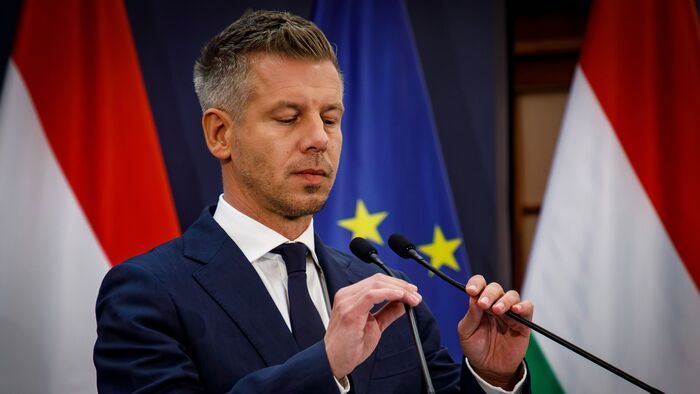
No. Only the names change, the character is the same. One was called Peter Marki-Zay, the current one is called Peter Magyar, but their role is identical. From time to time, Brussels pulls them out of the magic hat so there is someone to put Hungary on the Brussels track.

What is the Brussels track?
The Brussels track is a pledge of allegiance, where one must declare daily that Hungary's fate is tied to that of the European Union. That the EU is not declining but renewing itself. That there are no strategic mistakes, only a bright future. That is why powers must be transferred to Brussels: tax policy, energy policy, the pension system. Brussels has laid out these demands for us point by point in recent years. The same appears in the Tisza Party's program. They even call it that: a convergence program. We must become like Western Europe. We must become a country of immigrants, we must implement the migration pact, we must build migrant cities. 

The three sins that have ruined Western Europe are: prioritizing  the interests of global big capital over those of the people; admitting and resettling migrants; and indoctrinating children with woke and gender ideology. We reject all three. Today, this is the essence of national sovereignty. Brussels wants Hungary to give up resistance and become like them. The Tisza Party also represents this. This is an old story. We are now living through its latest edition.

In recent weeks, many old names have appeared as supporters of the Tisza Party, including Lajos Bokros, Maria Zita Petschnig, Laszlo Lengyel, Ildiko Lendvai, Gyorgy Rasko, or Peter Akos Bod.
Today there are two sides: those who stand for national sovereignty and those who stand for the European empire. These people have been saying since the early 1990s that Hungary must not only adopt Western tools and methods but must essentially assimilate into Western Europe. This has always been a dividing line in Hungarian politics. One school says we are Hungarians and therefore Europeans, as deceased Prime Minister Jozsef Antall said. The other says one must live as a European person in a territory called Hungary. They have always represented the latter. Now the pieces have found their match again.

The Tisza Party does not have an official program, but slips of the tongue and background materials reveal their intentions.
From these mosaic pieces, a well-known picture emerges. These are imprints of instructions coming from Brussels. The Tisza Party has chosen a method of winning the election not through debates about the future, but through incitement. It seeks to stir up hatred and contempt for everything that has been achieved over the past 15 years, everything that is valuable and a source of national pride. People must be made to believe that their lives can only improve if they trample on those who stand in the way of salvation from Brussels. That would be us. This is an emotion-driven political toolkit borrowed from Brussels. I believe that when deciding about our future, Hungarians will ultimately make a rational decision. And we will win an overwhelming electoral victory that exceeds all expectations. Reason will prevail over emotion. Patriots will defeat Brussels' people.

A fourth consecutive term, sixteen years of governing. What are you most proud of?
In recent years, for example, three Nobel Prizes have come to Hungary, and that is simply wonderful. Through our successes in advancing the country, we have restored the self-respect of the country and the Hungarian people. We showed that we are not a nation of defeat and retreat. We can win, and we will win over Hungarian misfortune. But if I had to name one thing: 

if we had not transformed Hungary in 2010, today there would be two hundred thousand fewer Hungarian children living in this country. That is how many more children are sitting under Christmas trees today. What could be more important than that?

So family policy is the key issue?
We built two major pillars. One is a work-based economy. We realized that Western Europe's greatest mistake was the illusion that one can live well without work and effort. That led to an economic system based on state benefits, which has now proven to be unviable. We said instead: only work, merit, and performance can sustain a country. We have transformed everything from education to family support to encourage extra effort. The other pillar is a family-based society. In contrast to the liberal approach, we consider the family, not the individual to be the basic unit of life. A work-based economy, a family-based society – this is what Hungarian life is built on today

If peace were to be achieved between Russia and Ukraine, what would be your first measure?
First of all, I would give thanks to God. At last week's war council in Brussels, it was proposed that we give Ukraine a loan of 90 billion euros, which would finance another two years of war. Hungary is staying out of this. But let us calculate: approximately nine thousand people fall out of combat every week on both sides. That is four hundred thousand people per year. In two years, eight hundred thousand dead or permanently disabled. Who dares to take moral responsibility for that? If we can be freed from this, our first response should be gratitude.

What is your message to Hungarians for Christmas 2025?
The Western world is in turmoil today. In such times, it is difficult to find something to hold on to. I return to a simple Christian teaching: love your neighbor as yourself. Right now, I am focusing not on the first part but the second: love yourself. This does not mean self-admiration or self-praise, but rather appreciating what we have achieved and not undervaluing the results of our own lives. A united family, properly raised and educated children, loyalty to friends, lovingly accompanying our parents along their path, securing and keeping a job, having our own home, living a confident, self-reliant life, any sacrifice made for our homeland. All of these are reasons for self-respect. Proper self-knowledge brings self-respect, and self-respect brings recognition of the successes and achievements of others, that is, love for ones neighbor. I see no other path that can lead Hungarians to peace.

Cover photo: Hungarian Prime Minister Viktor Orban (Photo: Prime Minister's General Department of Communication/Zoltan Fischer)

Komment

Összesen 0 komment

A kommentek nem szerkesztett tartalmak, tartalmuk a szerzőjük álláspontját tükrözi. Mielőtt hozzászólna, kérjük, olvassa el a kommentszabályzatot.


Jelenleg nincsenek kommentek.

Szóljon hozzá!

Jelenleg csak a hozzászólások egy kis részét látja. Hozzászóláshoz és a további kommentek megtekintéséhez lépjen be, vagy regisztráljon!

A téma legfrissebb hírei

Tovább az összes cikkhez chevron-right

Ne maradjon le a Magyar Nemzet legjobb írásairól, olvassa őket minden nap!

Google News
A legfrissebb hírekért kövess minket az Magyar Nemzet Google News oldalán is!

Címoldalról ajánljuk

Tovább az összes cikkhez chevron-right

Portfóliónk minőségi tartalmat jelent minden olvasó számára. Egyedülálló elérést, országos lefedettséget és változatos megjelenési lehetőséget biztosít. Folyamatosan keressük az új irányokat és fejlődési lehetőségeket. Ez jövőnk záloga.