Hungary FM: Ukraine Sees a Tisza Victory as a Strategic Objective

In an interview with Mandiner, Foreign Affairs and Trade Minister Peter Szijjarto sharply criticized the European Union’s pro-war policies and stated that, for Ukraine’s leadership, a victory by the Tisza Party in Hungary’s 2026 elections is a strategic interest. According to the minister, this is how Kyiv hopes to secure the financial support it seeks, advance EU accession, and draw Hungary into the war. Szijjarto stressed that the government will not allow Hungarian taxpayers’ money to be sent to Ukraine and will file a lawsuit against the ban on Russian energy imports, which he said was adopted through legal trickery. He warned that a Tisza win would bring triple utility costs and fuel prices approaching 1,000 forints per liter.

2026. 02. 06. 18:07
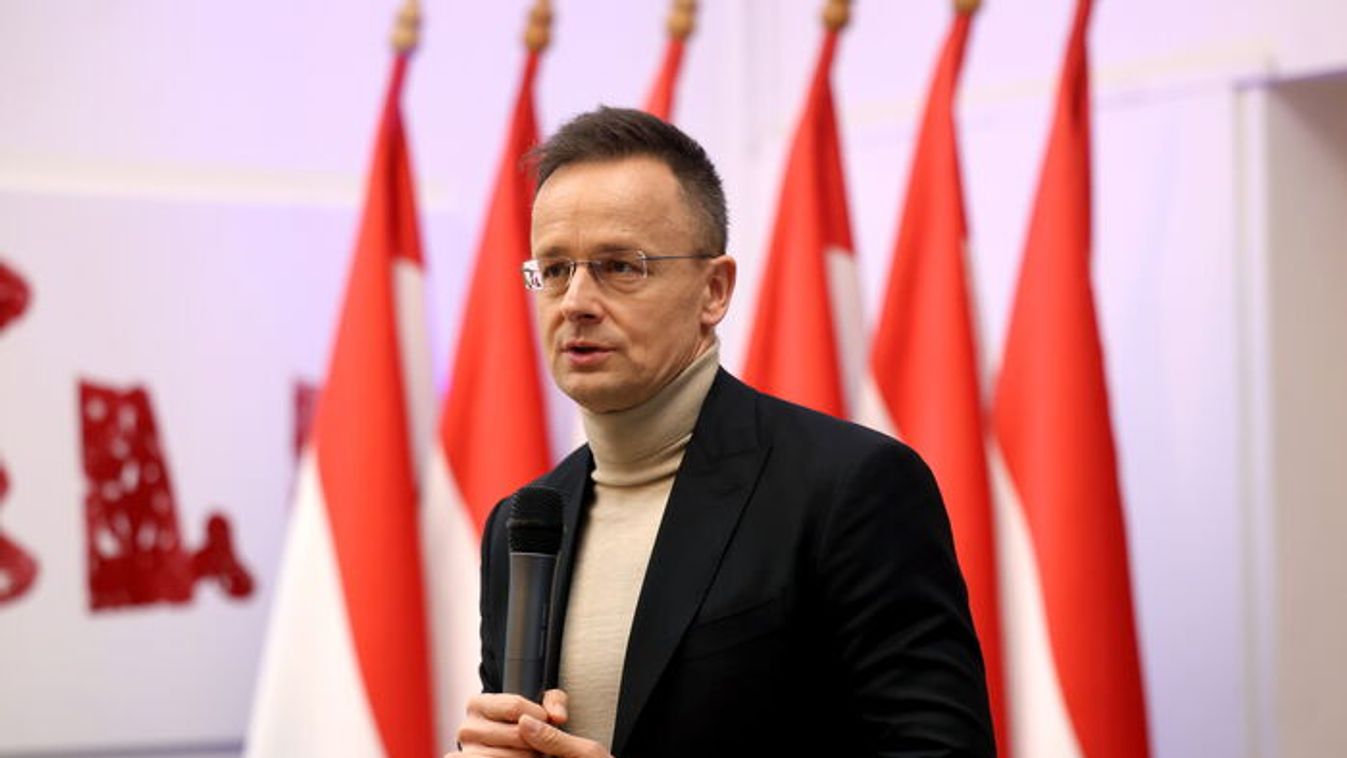
Peter Szijjarto, Hungary's Minister of Foreign Affairs and Trade, speaks at the year-opening forum in Miskolc on February 5, 2026 (Photo: MTI/Janos Vajda)
VéleményhírlevélJobban mondva - heti véleményhírlevél - ahol a hét kiemelt témáihoz fűzött személyes gondolatok összeérnek, részletek itt.

In his interview with Mandiner, Peter Szijjarto delivered a forceful critique of the European Union’s approach to the war in Ukraine, emphasized Hungary’s sovereignty-focused position, and described the upcoming elections in the spring as a turning point. According to the foreign minister, a Tisza Party victory is a strategic objective for Ukraine's leadership.

Szijjártó Péter külgazdasági és külügyminiszter beszédet mond az Evoring Precision Manufacturing Kft. gyárának átadásán Jászfényszarun 2026. február 5-én. A kínai autóipari beszállító 39 milliárd forintos új beruházása nyomán 450 munkahely jön létre (Fotó: MTI/Komka Péter)
Hungary's Foreign Affairs Minister Peter Szijjarto speaks at the inauguration of the Evoring Precision Manufacturing Kft. plant in Jaszfenyszaru on February 5, 2026.
The Chinese automotive supplier’s new 39-billion-forint investment will create 450 jobs.
(Photo: MTI/Peter Komka)

Brussels’ War Fanaticism and Hungary’s Isolation

According to Szijjarto, “war fanaticism prevails in Brussels.” He said the EU treats Ukraine’s war as if the Union itself were at war, and that common sense has lost its footing. While many privately agree with him in the corridors, he noted, they read out mainstream pro-war talking points in the meeting rooms. He added that he does not feel alone, as the Slovak and Czech foreign ministers have joined him on key issues.

In Brussels, war fanaticism dominates. They treat Ukraine’s war as if we ourselves were fighting it, and everything revolves around this issue—common sense has lost its base there,

the minister said.

The EU has already spent €150 billion on Ukraine, he noted, and pushed through an additional €90 billion in so-called war loans, in which Hungary, Slovakia, and the Czech Republic are not participating. Ukraine is now requesting another €800 billion to keep the state functioning and €700 billion for rearmament over the next ten years—€1.5 trillion in total—which, Szijjarto said, would be taken from European citizens. In his view, Ukraine will never repay this money because Russia will not lose the war.

The Ukrainians will obviously never repay this, since no reparations will come from Russia. Reparations are paid by those who lose—and Russia is not going to lose this war,

he emphasized.

Szijjarto: Nuclear War Has No Winners

The minister warned that plans by France and the United Kingdom to deploy troops could lead to a clash between nuclear powers—NATO and Russia—posing the risk of a third world war fought with nuclear weapons, in which there would be no winners. He reiterated that NATO decisions clearly state the alliance is not a party to the conflict and must not become one.

Direct confrontation—meaning any deployment of NATO troops to Ukraine—would carry the immediate risk of triggering World War III. Such a war would almost certainly be fought with nuclear weapons, and a nuclear war has no winners.

The Tisza Party, Ukrainian Interference, and the Elections

Szijjártó asserted that for Ukraine, a Tisza Party victory is a strategic matter and that Kyiv will do everything it can to achieve it, as this would open the door to Hungarian participation in the war, EU membership for Ukraine, and massive financing. He contrasted this with the will of the Hungarian people, who, he said, do not want to go to war, send money to Ukraine, or accept the country as a member.

The Ukrainians will do everything they can for a Tisza victory—this is now a strategic issue for them. Our task is to exclude any and all attempts at interference,

he underlined.

Commenting on Brussels’ latest decision, Szijjarto said the complete shutdown of Russian oil and gas imports was pushed through by “legal trickery”—classified as a trade measure requiring only a qualified majority, even though energy issues require unanimity. Hungary will challenge the decision in court. He warned that a Tisza victory would lead to supply disruptions, tripled utility costs, fuel prices of 1,000 forints per liter, and the collapse of industry and jobs.

If we cannot protect our access to cheap energy sources, we will face supply problems. […] Utility costs could triple, and fuel prices could jump to 1,000 forints per liter,

he reiterated. 

On migration, he said that while Hungary’s southern border fence provides protection, pressure is coming from the west due to the new migration pact.

As long as we are in government, we will not allow a single illegal migrant to enter—neither from the south nor from the west,

the minister declared.

Szijjarto emphasized that Hungary pursues a practical, not ideological, foreign policy, and that Prime Minister Viktor Orban uniquely maintains working relationships with Washington, Moscow, Beijing, and Ankara.

 

He also said that for the Hungarian opposition, ethnic Hungarians beyond the borders are merely campaign tools—something he claimed was evident when Peter Magyar did his march to Transylvania. He argued that Hungarians living beyond Hungary’s borders have gained ample experience over the past sixteen years and know that they can always count on the current pro-nation government—and this will continue to be so in the future.

Regarding the Benes Decrees, Szijjarto stated that Hungary speaks clearly: the principle of collective guilt is unacceptable, and any decision based on it is unacceptable as well.

We will protect every Hungarian in southern Slovakia from becoming the victim of any discriminatory decision based on the Benes Decrees,

he concluded.

Cover photo: Peter Szijjarto, Hungary's Minister of Foreign Affairs and Trade, speaks at the year-opening forum in Miskolc on February 5, 2026 (Photo: MTI/Janos Vajda)

Komment

Összesen 0 komment

A kommentek nem szerkesztett tartalmak, tartalmuk a szerzőjük álláspontját tükrözi. Mielőtt hozzászólna, kérjük, olvassa el a kommentszabályzatot.


Jelenleg nincsenek kommentek.

Szóljon hozzá!

Jelenleg csak a hozzászólások egy kis részét látja. Hozzászóláshoz és a további kommentek megtekintéséhez lépjen be, vagy regisztráljon!

A téma legfrissebb hírei

Tovább az összes cikkhez chevron-right

Ne maradjon le a Magyar Nemzet legjobb írásairól, olvassa őket minden nap!

Google News
A legfrissebb hírekért kövess minket az Magyar Nemzet Google News oldalán is!

Címoldalról ajánljuk

Tovább az összes cikkhez chevron-right

Portfóliónk minőségi tartalmat jelent minden olvasó számára. Egyedülálló elérést, országos lefedettséget és változatos megjelenési lehetőséget biztosít. Folyamatosan keressük az új irányokat és fejlődési lehetőségeket. Ez jövőnk záloga.