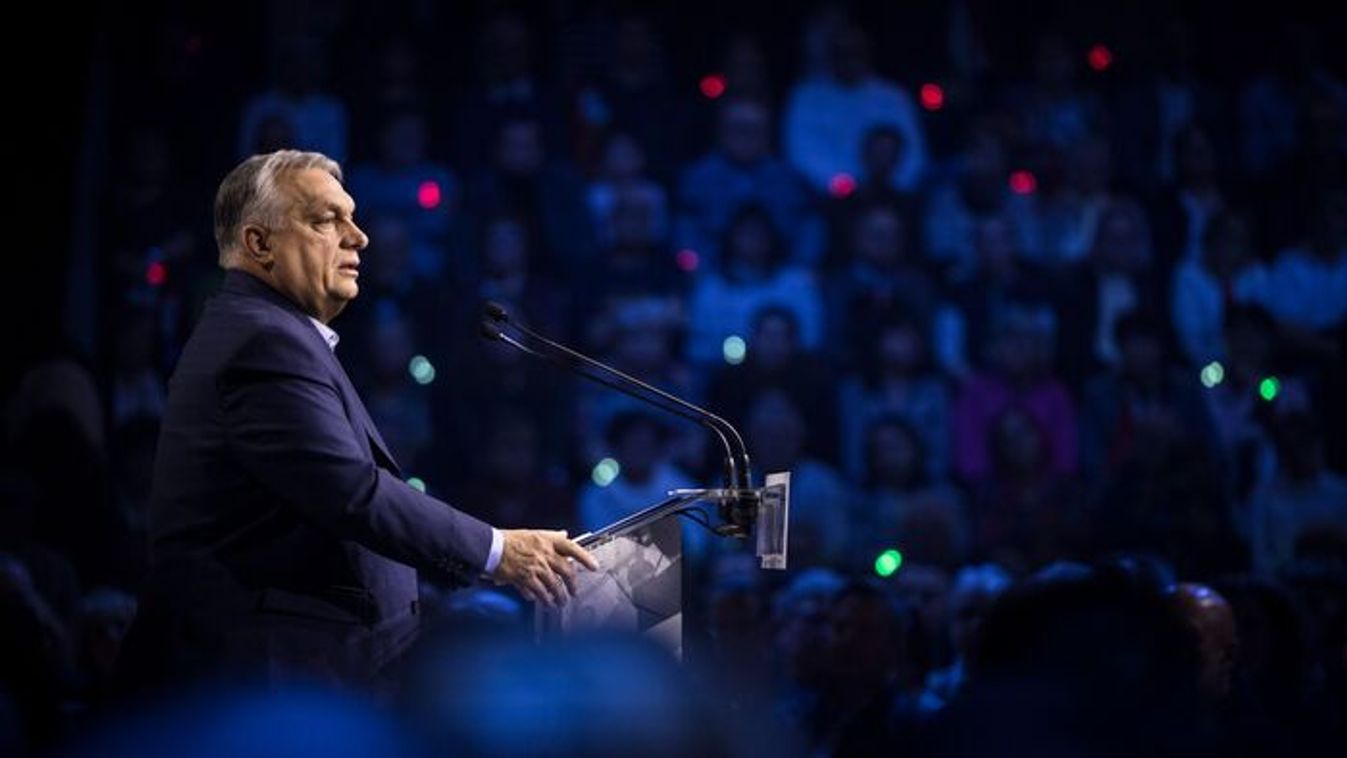
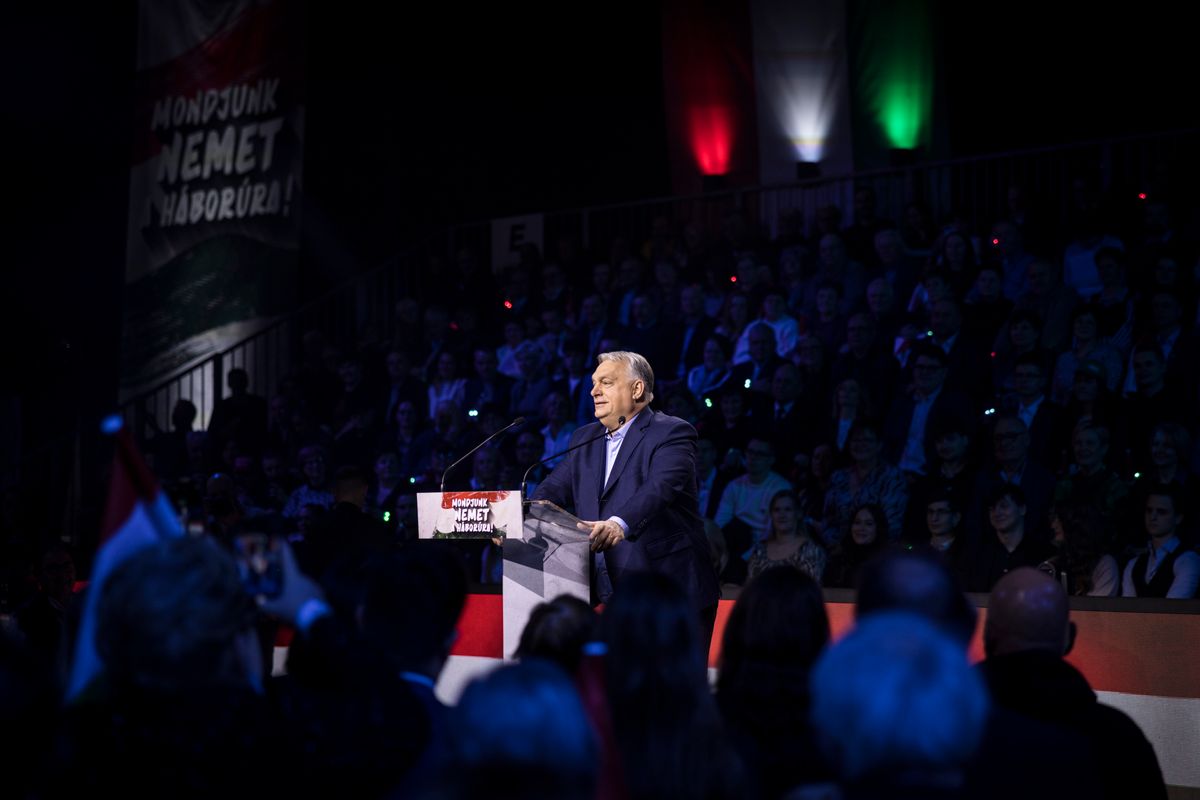
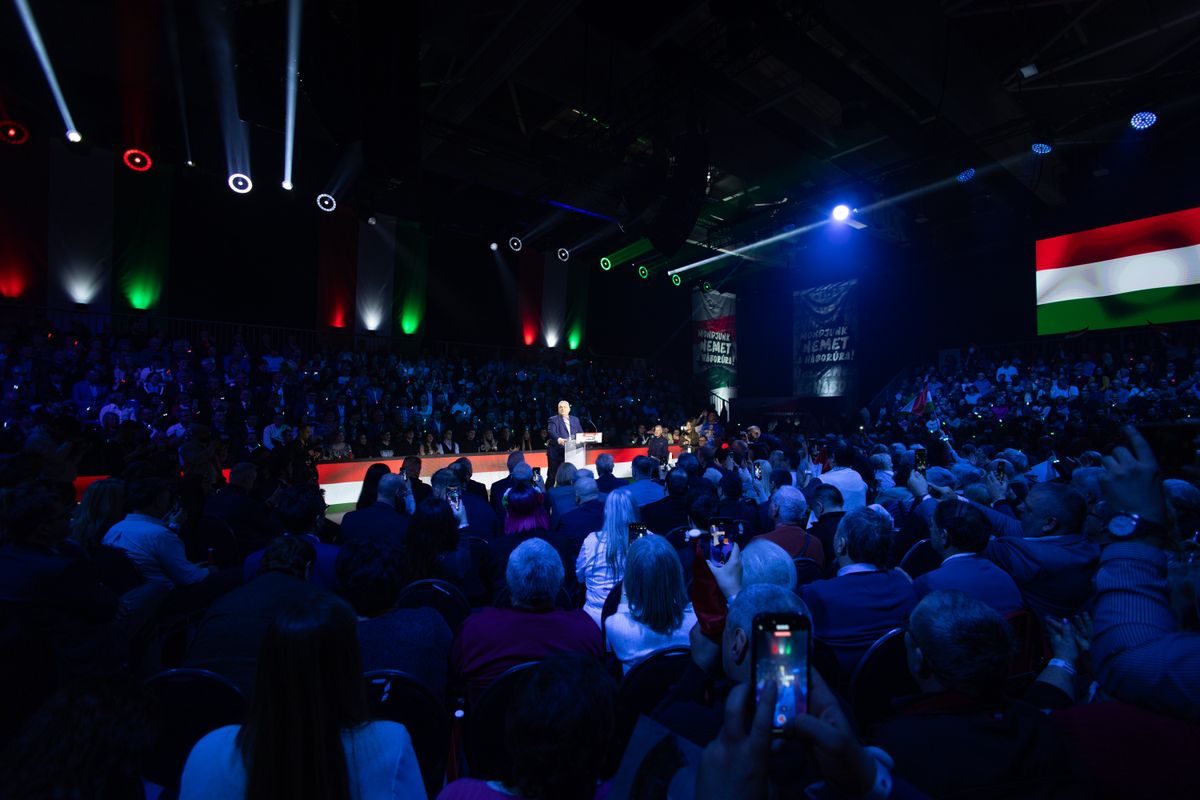
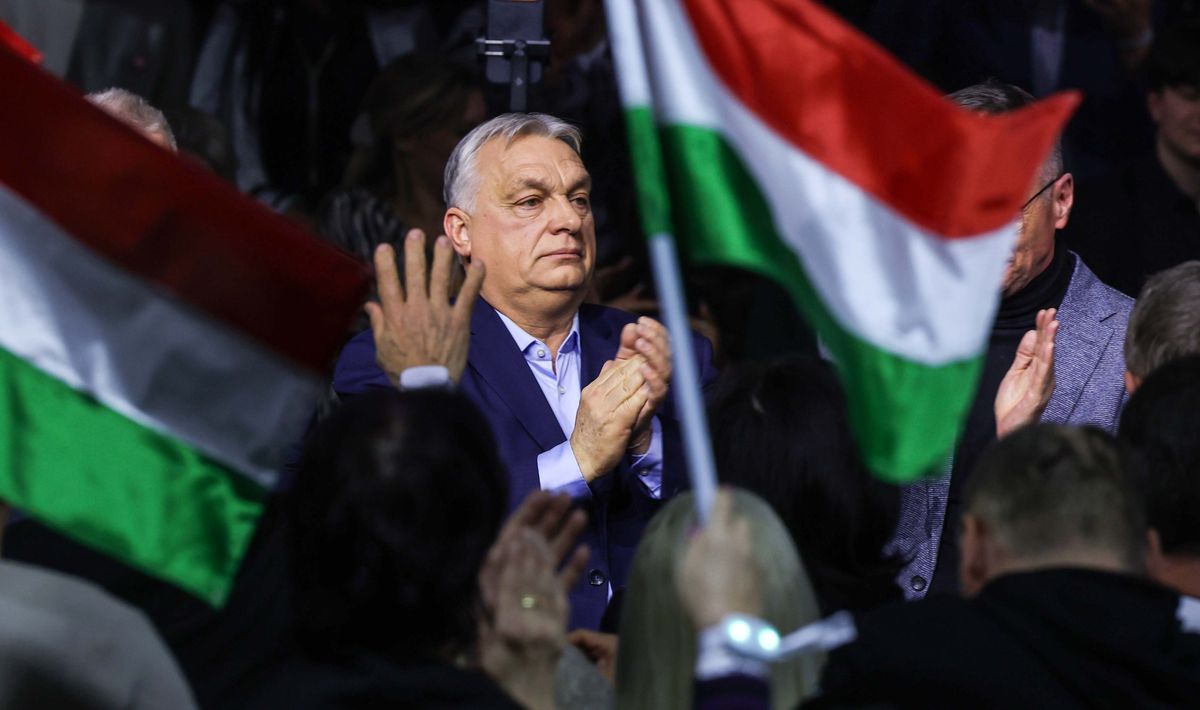
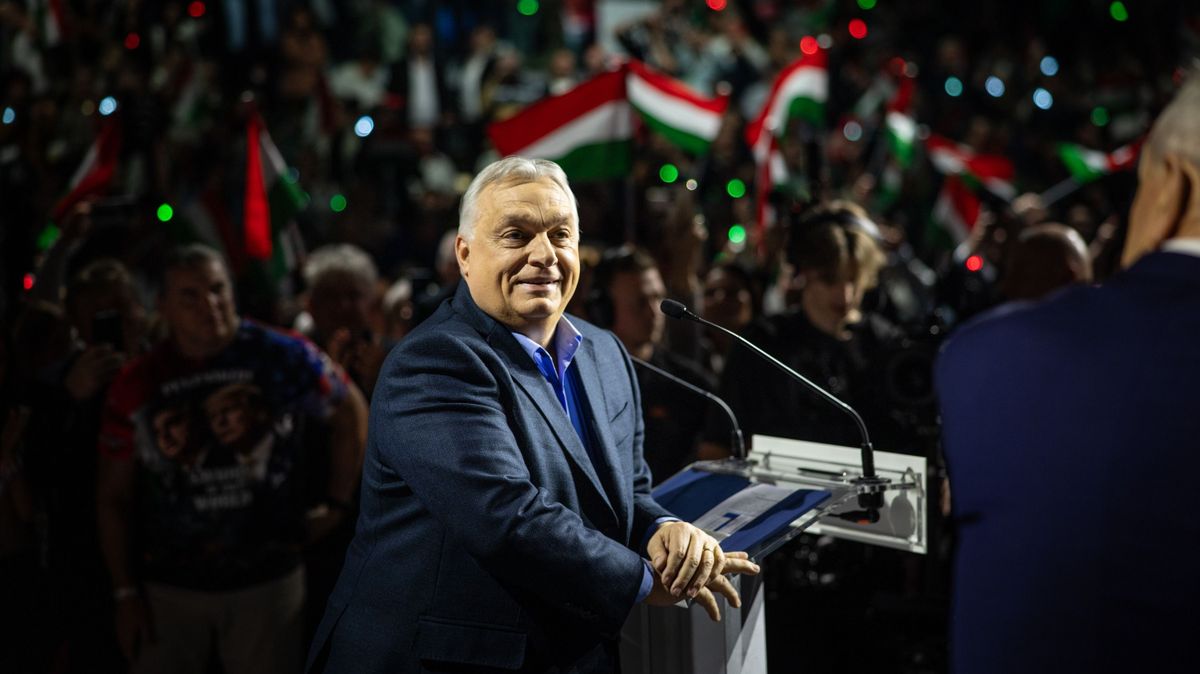
The nationwide tour of the Digital Civic Circles (DPK) held its Saturday event in the town of Hatvan, where Prime Minister Viktor Orban took the stage at the peak of the anti-war rally. He identified the preservation of peace as the most important task ahead and stressed that Tisza Party experts are falsely talking about the need for austerity measures. The solution, he argued, is to support people rather than take away from them. He also addressed the situation of Hungary’s Roma community, making it clear that Roma citizens deserve recognition and respect.
in Hatvan, there is no need to explain why war is bad.
“Here, war is not a theoretical issue—it is flesh-and-blood suffering,” he said, recalling the hardships the region endured during World War II.
The county newspaper, Heol, commemorated the 1944 bombing of Hatvan with a photo gallery, which can be viewed by clicking here.
Photo: Prime Minister's Office, Communications Department
Following the speech, audience questions were moderated by Philip Rakay, ambassador of the Digital Civic Circles (DPK).
Responding to a question about the automotive industry, Orban said it is a vital sector in Hungary, providing livelihoods for hundreds of thousands of families. He reassured workers that they have no reason to worry: car manufacturing has a future, and Hungarian plants are more competitive than most abroad.
He criticized Brussels for forcing an aggressive green transition that has proven unrealistic. Hungary, he said, has made major investments to keep vehicle manufacturing at home and to be part of the industry’s next phase—hence the construction of battery plants and new car factories, including the BMW plant in Debrecen. “We are on the right track,” he said, adding that
the Raba plant in Gyor will restart production in March,
restoring independent truck manufacturing in Hungary.
On Roma–Hungarian coexistence, Orban said tensions are running high currently. “There are two ways we can help: through work and through education. Take up jobs, and make sure children attend school,” he said. Many Roma families, he noted, have taken advantage of opportunities for advancement. The number of Roma with high school diplomas has doubled, many have found work, and large numbers have moved from public employment into the private labor market.
There is still much to be done, he acknowledged. Today, 3 percent of Roma have a higher education degree, and 11 percent hold a high school diploma.
“Everyone has dignity, and when people hear a sentence that makes them feel they are only good for so much, that dignity is hurt,” the PM said. In politics, he added, a poorly worded sentence can miss the mark and must be addressed. “A person’s value is defined by the quality of their work. I place a cleaner who does their job well above a university graduate who does not. Those who work well deserve respect, and that is why it is worth returning to the cooperation we began in 2010.”
He added that he understands why Roma communities felt hurt by remarks made by Janos Lazar, as they felt they were being judged as capable of no more than that.
The Roma community deserves recognition and respect,
Orban said, stressing that their future is in their own hands.
He made clear that he will not allow anyone to be forced into a fate they did not choose for themselves.
Referring to the recent incident at the “Lazarinfo” event in Gyongyos, PM Orban said he had never before seen criminals organized into gangs and sent by a political party to disrupt a peaceful gathering.
“We will not accept this,” he declared. He noted that those allegedly sent by Tisza against Fidesz supporters have criminal records including homicide, robbery, coercion, theft, and sexual assault.
Let this be our message to the Tisza activists: do not incite Roma against Roma, or Roma against Hungarians. This is the only way we can preserve peace in Hungary,
Viktor Orban added.
Brussels and Tisza Want to Scrap Utility Price Cuts
Speaking about the firewood aid program, the prime minister explained that local governments submit their needs and handle distribution. There is currently no upper limit, he said—the government will provide as much support as necessary. Police officers and firefighters patrol the area, and where there is no smoke coming from a chimney, they go inside to check on residents, he added.
Turning to household utility costs, PM Orban stressed that there is no comparable system anywhere else in Europe. Elsewhere, there is no across-the-board reduction in utility prices—only targeted assistance programs. Nowhere else does the entire population receive cheaper energy bills. That, he said, exists only in Hungary.
“This is precisely what Brussels is attacking,” Orban said. “What we do is take away the excess profits that large energy companies would otherwise pocket, add the bank tax, and return that money to families as support. As for Russian gas, the reality is that it is cheap—and without cheap gas, there is no utility price reduction.”
“If Hungary is cut off from affordable gas, people will pay three or four times as much for utilities as they do now,” he warned.
“Those who want this must be kept away from power,” Orban said, adding that a former Shell executive—representing what he called a predatory multinational—has now been sent in. Shell, he noted, has recently doubled its profits and is boasting about it, while the Tisza Party’s energy policy figure praises this outcome and seeks to push out Russian suppliers. That, Orban argued, is why a growing number of energy lobbyists are gravitating toward the Tisza camp.
According to the prime minister’s view, the economy serves three core goals: providing jobs, ensuring people can earn enough to own a home, and securing pensions. Utility price reductions, he said, fit squarely into this framework. He made it clear that
the government will stand firmly by the utility cost reductions.
“I’m not crazy. Anita Orban may share my last name, but I’m not replacing Peter Szijjarto with her,” Orban said, noting that she is a lobbyist whose current role is to press demands against the Hungarian government.
Orbán said the backers of the Tisza Party’s foreign policy expert want Ukraine admitted to both the EU and NATO as quickly as possible. In his view, Ukraine’s accession would create both a war-related and an economic crisis.
Fotó: Miniszterelnöki Kommunikációs Főosztály
Say No to War
Orbán pointed out that Ukraine has stated it needs $800 billion over the next ten years just to keep the country running, plus another $700 billion for military spending. He noted that Hungary has managed to stay out of the next €90 billion financial package for Ukraine, meaning it will not burden Hungarian taxpayers.
The prime minister again presented the questions on the national petition.
When I have to fight against Ukraine’s EU membership, I can do so because I can say there was a vote in Hungary, and the people decided they don’t want this,
PM Orban emphasized. Cooperation is possible, he said, but membership status cannot be granted.
“How does President Zelensky speak to those he wants to join?” Orbán asked, recalling a meeting in Kyiv where he warned Zelensky that time was not on Ukraine’s side. According to Orban, Zelensky bluntly rejected that assessment, insisting that time favored Ukraine, that a longer war would bring victory, and that Russia would eventually be forced to pay reparations.
Orban recalled pointing out that Joe Biden was then U.S. president, but if Donald Trump returned to office, the United States would not provide funding and would not allow itself to be dragged into the war. Zelensky, Orban said, did not take that seriously.
The prime minister also described a conversation with Russian President Vladimir Putin, whom he asked how strongly Russia insisted on Donetsk. Putin replied that while Ukrainians fight well, Russia is stronger and will take all of Donetsk.
“That is the reality—war is about power,” Orban said. “This is why war is a risk for Hungary. Europe, as opposed to the Americans, wants confrontation and is talking about sending troops. If that happens, soldiers will be sent from here as well. Everyone who doesn’t resist will be dragged in.”
Hungary, he said, can stay out—but only with skill and resolve.
I can keep Hungary out of this. Our generation’s task is to say no. With the people parachuted into the Tisza movement, it’s impossible to stay out—and in truth, they don’t even want to stay out.
Orban argued that time is on Hungary’s side. Europeans, he said, do not want to go to war and do not want their money sent to fund it. European leaders claim the war will not cost voters anything because Russia will be defeated and forced to pay reparations—an illusion, the PM said. Russia will never be defeated on the battlefield.
“Every day I have to fight to get the message across: stay alert,” he said. “In the battle between war and peace, peace will prevail in Europe—and we will lead that fight.”
The prime minister also said the left underestimated migration in the past, just as it now underestimates the dangers of war and military involvement.
“We were alert on migration—we built a fence. Without it, we would not be living the way we do today,” he said. “Europe chose the path of migration, and we can all see the result.”
"The same," he warned, "applies to war. Once you step onto that path, you cannot step back.”
Europe, he said, has embarked on a road to war and cannot turn around. The Tisza Party, he added, wants a Brussels-style system built on war. That would financially ruin the country—and perhaps even send to war Hungary’s children. “We must relentlessly say no to war,” Orban stressed.
Asked whose side Hungary is on, he replied: “We are on Hungary’s side. Why should we align our position with someone else’s interests?”
A Government of the Countryside
PM Orban spoke at length about rural Hungary, noting that after 1956 a growing divide emerged between cities and the countryside. For the past sixteen years, he said, the government has worked to close that gap.
“You cannot deny development opportunities to rural areas,” he said. “If there is someone who has done a great deal for this, it is Janos Lazar. It may not sound good in Budapest, but Hungary today has a government of the countryside.” He pledged that rural communities can continue to count on the government over the next four years.
On a post-election new government formation, Orban said coalition governments are a bad sign from the outset. He recalled that between 1998 and 2002, he was part of such a government and coalition infighting consumed 70 percent of his energy.
“We don’t form governments to hand out positions—we form them to govern the country well,” he said. First, leaders must understand what lies ahead, then define their goals, and only afterward choose the right people. One of the key challenges ahead, he said, is staying out of the war.
Photo: Zoltan Havran
Support People—Don’t Take from Them
Orbán highlighted the continuation of existing programs, particularly support for mothers.
“This is not welfare,” he said. “We believe the family is at the center of life, so it must also be at the center of economic policy.” The goal of family tax benefits, he explained, is simple:
those who raise children should not be worse off than those who do not.
He stressed that women are the backbone of families and mothers must therefore be supported.
The prime minister also said the condition of families and the nation are inseparable.
“People’s intimate relationships are their own business, but the family is different—it sustains the nation. Two women or two men cannot do that,” he said. “We represent values others do not, no matter how many rainbow flags they wave.”
Orban added that technological change must also be understood and managed carefully.
“Allowing modern technology in without letting it tear us apart will be one of the great challenges of the next four years—because we must protect our children,” he said.
He recalled that in 2010 the government promised one million new jobs—and delivered. He added that average wages will also reach one million forints.
“What the Tisza Party is proposing would break the backs of Hungarian families,” Orban warned.
He said those preparing for a change of government are already explaining why they will have to take people’s money, talking up economic hardship—but there is no need for austerity.
“We don’t need cuts,” the prime minister declared.
“We don’t need to take anything away from people—we need to support them.”
Closing his remarks, the prime minister thanked supporters and said he would continue to rely on them.
“God above us all, Hungary before all else—go Hungary, go Hungarians!” PM Orban concluded with his usual rallying cry.
At the end of the rally, Philip Rakay announced that the Digital Civic Circles (DPK) national tour will continue next week in Szombathely.
DPK continues its tour of the country (Photo: Prime Minister's Office Communications Department/Zoltan Fischer)
Viktor Orban Arrives in Hatvan
Prime Minister Viktor Orban has arrived in Hatvan for the event, where he is set to address the gathering and answer questions from attendees.
This is Hatvan—we’re home,
the prime minister declared. “There is peace here,” he added in a social media post.
Last week, the DPK anti-war rally was held in Kaposvar, where Orban departed from the traditional speech format and instead responded directly to questions from the audience. At that event, the prime minister also presented the questions included in the national petition launched by the government.
Say no to financing the Russia–Ukraine war.
Say no to ten years of financial support for Ukraine.
Say no to higher utility prices as a consequence of the war.
These three points form the core of the government’s national petition, which allows Hungarians to reject further funding of the Russia–Ukraine war, as well as efforts to make them pay for the operation of the Ukrainian state over the next decade. The petition also gives citizens the opportunity to say no to war-driven increases in household utility costs.
The prime minister emphasized that if Ukraine were already a member of the European Union, the EU would now be in a direct military conflict with Russia.
Ukraine must remain outside the European Union. Letting them in would be life-threatening and would expose Hungary to a permanent risk of war,
PM Orban added.
Cover photo: Hungary's Prime Minister Viktor Orban at the Digital Civic Circles (DPK) anti-war rally in Hatvan (Photo: Prime Minister’s Communications Office).
A Magyar Nemzet konzervatív, nemzeti-kulturális hetilap, amely nemcsak híreket közöl, hanem értelmezi is a világot. Hiteles szerzőkkel, mélyebb összefüggésekkel és időtálló gondolatokkal segít eligazodni a közélet, a kultúra, a történelem és a mindennapi élet kérdéseiben.
A Magyar Nemzet konzervatív, nemzeti-kulturális hetilap, amely nemcsak híreket közöl, hanem értelmezi is a világot. Hiteles szerzőkkel, mélyebb összefüggésekkel és időtálló gondolatokkal segít eligazodni a közélet, a kultúra, a történelem és a mindennapi élet kérdéseiben.
Portfóliónk minőségi tartalmat jelent minden olvasó számára. Egyedülálló elérést, országos lefedettséget és változatos megjelenési lehetőséget biztosít. Folyamatosan keressük az új irányokat és fejlődési lehetőségeket. Ez jövőnk záloga.